What Does Bujang Valley Prove?
Kedah's earth hides real temples, real ironworks, and real ports — but the writing on the stones is not Malay
If you are arguing with someone about "who came first," the Bujang Valley (Lembah Bujang) is a very tempting card to play.
The largest ancient architectural complex on the Peninsula lies right in the earth of Kedah, right within the borders of modern-day Malaysia. Temples, furnaces, port docks — older than any Old Malay inscription in Sumatra.
The problem is, once you play this card, you will find that the words written on it are not what you thought.
It Is Real#
Let's make this point clear first; it cannot be bypassed.
There are indeed things in the Bujang Valley. 1,5
From the first wave of survey excavations by H.G. Quaritch Wales in the 1930s, to the continuous discoveries of new sites at Sungai Batu after 2008, over fifty ancient architectural ruins have been identified in this area. 1,5 Three types of sites coexist: candi (stone foundations of Hindu and Buddhist temples), iron-smelting sites (furnaces, slag, ore deposits), and ancient river ports around Pengkalan Bujang, where merchant ships once docked and unloaded their cargo.
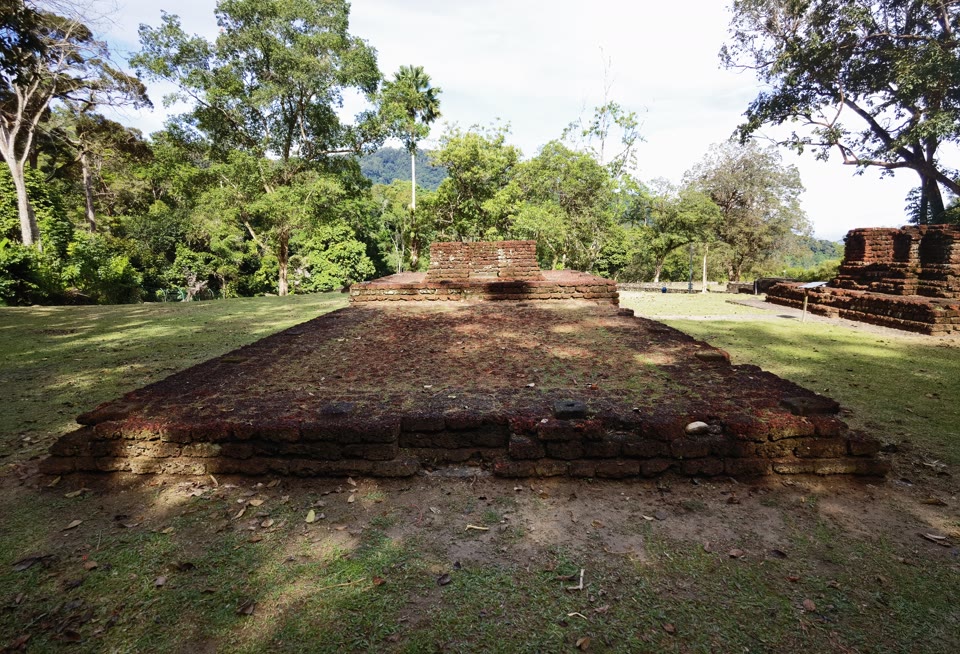
Hinduism and Buddhism coexisted here simultaneously, not one after the other. 1,2 There are about nine Buddhist ruins and about fifteen Brahmanic ruins — two sets of deities sharing the same land, serving the same diverse groups of merchants from all over.
So, what is here? An international port that operated for hundreds of years, with temples, smelting sites, and berths. This is true.
Dating: Let's Be Honest#
So, how old is it?
There is a controversy here that needs to be clarified, because many circulating claims are inaccurate.
The sites in the Bujang Valley have been active since at least the 2nd century CE, possibly earlier. 6,7 The academic community generally has no disagreement with this lower bound.
But you may have heard another number: 788 BCE, or "the earliest civilization in Southeast Asia." This claim stems from a set of carbon dates from Sungai Batu (Site SB2H, layer 7), with a range of 788–537 BCE, which was later compressed into a single year for public release. 6,7
John Miksic of the National University of Singapore stated plainly: "Archaeologists usually do not rely on a single carbon-14 date." The opinion of Charles Higham from the University of Otago was similar — a single outlier is insufficient to establish a chronological sequence. These public criticisms were featured in a 2023 report by Scoop.my. In 2024, the academic journal MINDEN Journal published a peer-reviewed critique, arguing that the claim relied on a single sample and that no artifacts from that layer could be dated to the 8th century BCE.
This controversy has not reached a final conclusion. But that "788 BCE" written in textbooks or press releases is currently in this state: questioned by international academia and not yet accepted as an established date.
This site's stance: use the one with consensus. Active since at least the 2nd century CE, possibly earlier. This is old enough; there is no need to borrow a disputed number.
What Language Is Written on the Inscriptions?#
This is the crux of the whole story.
The inscriptions unearthed in the Bujang Valley, as well as several important stone steles discovered in nearby Seberang Perai, feature scripts from the Brahmi/Pallava family from southern India. The language is Sanskrit or Pali. All currently unearthed inscriptions are written in Sanskrit or Pali; no stone stele using the Malay language has ever been found. 3,4
Let's look at the two most important inscriptions first.
The Buddhagupta Inscription, 5th century CE. 3,2 It was discovered in 1834 by James Low, a British East India Company officer stationed there, at Guar Kepah in Seberang Perai (the mainland part of Penang) — not in the temple zone of the Bujang Valley, a point that is often confused. The original stone is now housed in the Indian Museum in Kolkata; a replica was gifted to the National Museum of Malaysia in 1961, and the piece in the Bujang Valley Museum is also a replica.
What does the inscription say? Two parts: one is a stanza (gatha) on karma; the other is a maritime thanksgiving inscription, naming the carver as Mahanavika Buddhagupta, from Raktamṛttika in modern-day Bengal. 3,2
This name is worth a pause. The carver was a sea captain from Bengal who, in the waters near Kedah, used Sanskrit to record his wishes. He was not here to settle — he was passing through, doing business, and thanking the gods for granting him a safe voyage.
The Cherok Tok Kun Inscription, 5th–6th century CE. 4,5 Located at the foot of Bukit Mertajam in Seberang Perai, today inside the courtyard of a Catholic church. The script is Pre-Pallava, and the language is Sanskrit or Pali — there is academic debate between the two, but regardless, neither is Malay. It consists of seven groups of inscriptions, one of which mentions a "King Ramaunnibha" defeating his enemies, while the rest are unreadable due to the weathering of the stone surface.
Two inscriptions, both in Seberang Perai, both first recorded by James Low, both using scripts from the Sanskrit world, and neither containing Malay.
This is not the stance of this site; it is the reality of the unearthed artifacts.
What Do Genetic Studies Say?#
There is another layer of evidence pointing in the same direction.
According to a genomic study by Hatin et al. published in The HUGO Journal in 2014 (DOI 10.1186/s11568-014-0005-z), the Malay sub-population in the northern peninsula, including Kedah Malays, shows higher genetic admixture from the Indian subcontinent than Malay sub-populations in other parts of the peninsula. This is a qualitative description; the paper does not give percentages, and this site will not invent one. This mutually corroborates with the archaeological record of Kedah as an Indianized port historically.
One thing must be made clear here: this study talks about the Kedah Malays of today, not the people of the 5th century CE. What it tells us is a history of admixture — the genes of South Asians flowed into the populations in this region, and this event left a mark genetically.
But genetic admixture does not equal "they are descendants of the same group of people," much less "those temples were built by these people." A genetic map records hundreds of years of flow, not a property deed for an ethnic group.
What Were Those People Called?#
Alright, so there are ancient ruins here, Indianized inscriptions, and South Asian genetic markers. So, what did the people who lived here call themselves?
This is the most important question in this article, and also the one most easily skipped over.
Before the founding of Malacca, the people in these places, even if they were already speaking some form of Malay, did not refer to themselves as "Malays." 8,9 They said they were Kedahans — simply that, calling themselves by the place they inhabited.
The word "Melayu," prior to the founding of Malacca, referred to a place in Sumatra, not the Peninsula, and not an ethnic group. 8,9 The 1365 Javanese court text Desawarnana lists place names under the "Land of Melayu," all of which were in Sumatra; when mentioning Peninsular settlements, it wrote "Pahang," not "Melayu."
This is not saying "these people are not the ancestors of the Malays." It is saying: the framework used to categorize people had not yet appeared on this land during that era.
This is not just one scholar's opinion. Andaya traced the referent of the word "Malay" through historical sources, while Milner approached it from the history of identity formation — two independent research paths, leading to the same conclusion: the "Malay" identity consciousness was established historically; it was a process, not a starting point. 8,10
(This site has not yet obtained the page numbers for Milner's book, so it only paraphrases his thesis and does not quote the original text.)
Whose Bujang Valley Is It?#
Buried in the land beneath your feet is a real civilization — temples, furnaces, berths, a port that operated for centuries, where people from all corners of the Indian Ocean came to do business, worship gods, and carve inscriptions. This is something every Malaysian should know and cherish, regardless of your background.
But "there are ancient things here" and "these things prove a certain ethnic group has been here since a long time ago" are two different matters.
Archaeologist Andaya, when studying the Bujang Valley, wrote: the ruins here cannot link their inhabitants to any specific ethnic group. Immediately after, he added: forcing archaeology under political pressure to unearth "the ancient roots of a dominant group" is something that has happened in many countries.
This is not an accusation against anyone. It is a researcher reminding his peers: what a shovel digs up and what politics wants it to prove are not necessarily the same thing.
Those inscriptions are in Sanskrit. That sea captain from Bengal thanked the gods in Sanskrit. Those temples were shared by Brahmanism and Buddhism. As for the inhabitants of old Kedah, it is very difficult for us to use today's concepts of race to determine which ethnicity they originally belonged to. They later learned Malay, and later assimilated into an identity that was later named "Malay." But that happened later.
Disclaimer: This site is for independent civic education writing and does not represent any political party. All citations in the text are verifiable, and historical facts and commentary are clearly demarcated in layers.
Sources 10 Every important claim here can be checked. Open it and see.
Do not trust this site. Check it — every source below is clickable.
-
Search for this source ⌕ no direct link — this button searches for the work 2026-07-30 Report this source
-
Search for this source ⌕ no direct link — this button searches for the work 2026-07-30 Report this source
-
Search for this source ⌕ no direct link — this button searches for the work 2026-07-30 Report this source
-
Search for this source ⌕ no direct link — this button searches for the work 2026-07-30 Report this source
-
Search for this source ⌕ no direct link — this button searches for the work 2026-07-30 Report this source
-
Search for this source ⌕ no direct link — this button searches for the work 2026-07-30 Report this source
-
Search for this source ⌕ no direct link — this button searches for the work 2026-07-30 Report this source
This site is written with AI assistance. Please check us.
AI can invent citations that look completely convincing — a real author's name, a plausible title, a sensible year, for a work that does not exist. This is not a theoretical risk; it is a known failure mode. That is why every source on this site is clickable. If a reference cannot be found anywhere, it may well not exist — and we want to know.
How to check us →
Reader Comments
Be the first to share your thoughts.