What Was Srivijaya and Why Did Palembang Matter?
From the seventh to the eleventh century, how a maritime power relying on taxes rose and fell
Imagine a toll booth.
Not on a road, but at sea. A strait with shores on both sides; the wind passes through here, ships pass through here, and there is no other way around.
The entity sitting in that toll booth was called Srivijaya.
1988: Excavators Enter Palembang#
Palembang, in southeastern Sumatra, with the Musi River flowing through it.
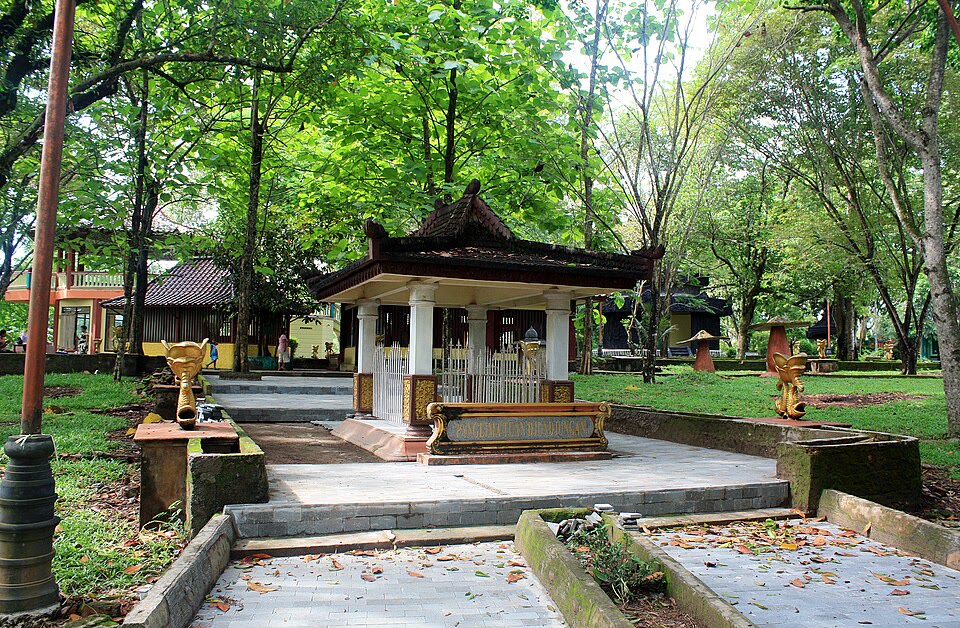
In 1988, an archaeological team arrived there and started digging. They dug along a stretch of the Musi River — from Bukit Seguntang all the way to Sabokingking — for three years. 1,2
What did they dig up?
A city.
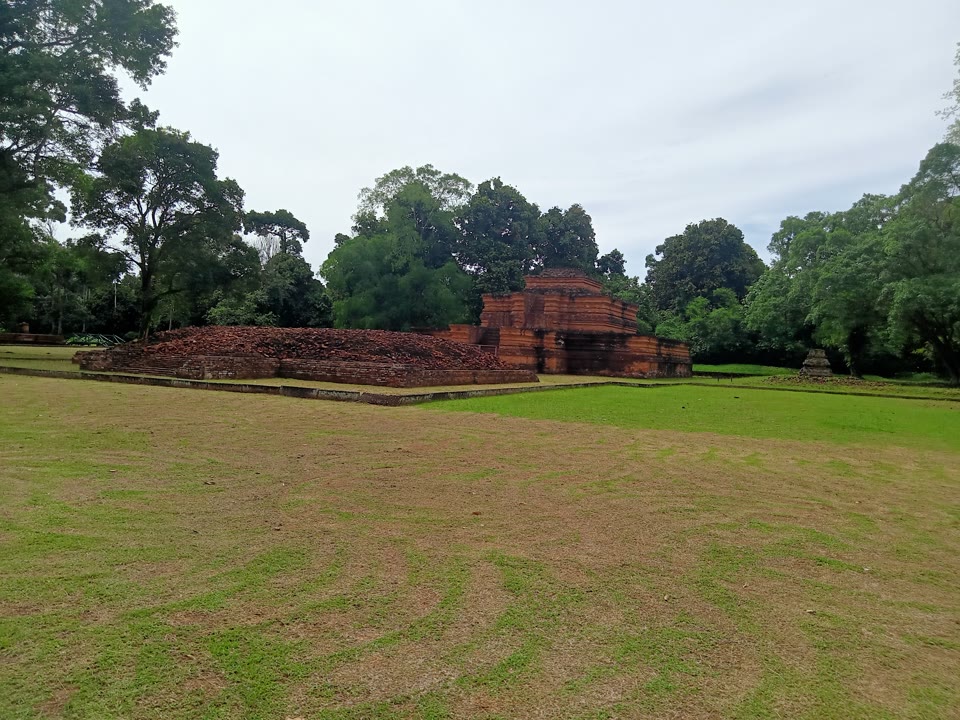
Canals, moats, artifacts, traces of settlement — physical archaeology outlined the contours of that city piece by piece. 1,2
Before those excavations, the question of "whether Palembang was indeed the capital of Srivijaya" was heavily debated among scholars. Wolters suggested the political center might have been in Jambi; Bronson and Wisseman argued Palembang had no urban scale at all. 5,1
After the excavations, the debate essentially ceased.
The capital of Srivijaya was in Palembang. It wasn't deduced from books; it was dug out of the dirt.
An Empire That Didn't Fight#
The stone inscriptions mentioned in the previous article were erected by this regime.
The Kedukan Bukit Inscription (682/683 CE) records a "sacred expedition" (siddhayātra), an army setting out from the hinterland and establishing a new settlement by the river. 2,1
But the smartest thing about Srivijaya wasn't the wars it fought.
It was a mandala polity — political scientists use this word to describe a specific type of Southeast Asian regime: the capital is the center, influence radiates outward, but there are no clear borders, and the allegiance of the margins is fluid, gathering and dispersing over time. 2,5
You don't need to occupy a piece of land to control it. You just need to make others feel: if you pass through this sea, it's best to say hello.
The price of that greeting was a tax.
If a merchant ship wanted to enter the Strait of Malacca, it had to pass through waters controlled by Srivijaya. Pay the tax in exchange for protection, supplies, and port facilities. Don't pay, and bear the risks yourself. 2,1
This model had a beautiful byproduct: it turned the capital into an unavoidable transit port. Whether going to China, India, or Persia, you had to pass through here. The people passing through brought money, and they also brought knowledge.
Yijing Stayed for Six Months#
In 671, the Chinese monk Yijing stopped in Srivijaya for half a year on his way to India to obtain scriptures. 3,2
He later wrote that Buddhist monks there "numbered over a thousand," and advised future Chinese peers to stay here for a year or two before heading west — to learn Sanskrit, study doctrine, and sharpen their tools before moving on. 3,2
Yijing himself stayed there for six months before continuing his journey, exactly for this reason.
What does this tell us? This was not just a trading port; this was an academic center. Merchants came here to exchange goods; scholars came here to exchange ideas. Both could happen at the same time because this place had the capacity to host both kinds of people simultaneously.
It relied on its port, not its borders.
"Sanfoqi"#
The Chinese called it Sanfoqi.
From the Tang to the Song dynasties, the "Sanfoqi" in Chinese historical records was Srivijaya — it sent tribute to China, China endorsed it, and this relationship served both sides well. 2,6
For Srivijaya, Chinese investiture meant legitimacy. I am a true power, recognized even by the Emperor of the Middle Kingdom.
For China, the tribute system meant smooth trade routes and stability in the South Seas.
Both sides got what they needed, and the relationship was maintained — until someone from another direction came to break it.
1025: Ships from the South#
Southern India, the Coromandel Coast.
In the early eleventh century, the Chola dynasty reached the peak of its power. King Rajendra Chola I reached out toward the South Seas.
In 1025, he dispatched a fleet. 4,7
We know about this because there is an inscription to prove it. A Tamil eulogy carved on the south wall of the Rajarajesvara Temple in Thanjavur — according to academic accounts, the inscription lists thirteen attacked locations, including Kadaram (identified by scholars as Kedah) and Sri Vijaya. 4,7
This list of place names has been cross-verified by this site from two independent secondary sources — the original Tamil text is in Hultzsch's 1891 epigraphic publication, but since we could not directly access the primary source this time, citing it requires the caveat "according to academic accounts."
The result of the attack is clearly recorded: the Srivijayan King Sangrama Vijayottunggavarman was captured. 4,7
One item was specifically named as being plundered — the "Jewelled War Gate" (Vidhyadara Torana), which scholars say was a symbol of Srivijayan power. 4,7
And then?
Three Years Later, Tribute Resumed#
This is where the story gets truly interesting.
In 1025, the Chola fleet attacked, sacked the capital, and captured the king.
In 1028 — three years later — Srivijaya had already resumed its tribute trade with China. 4,7
If this were a conquest, the aftermath shouldn't look like this. After a conquest, there would be administrative institutions, garrisons, and traces of occupation left on the land and in the historical records.
But there weren't.
Archaeologically: no administrative ruins or architectural remains belonging to Chola rule have been found in Palembang. 1,4
Historically: there is no evidence that the Chola established long-term governance over Srivijayan territory. 8,7
However, a divergence should be noted here: some summary materials state that the Chola "occupied Kedah for some time." This site adopts the judgment of two academic works specifically studying the Chola expedition — it was a plunder, with no permanent administrative apparatus. This is not an uncontested conclusion.
The academic consensus is: this was a punitive commercial strike, not a war of conquest intended for permanent occupation. 8,7
The Chola didn't want this land. They wanted Srivijaya to know who was stronger — and perhaps gain leverage to renegotiate trade terms.
They fought, took what they wanted, and left.
We should pause here to be fair. The conclusion of a "punitive strike" is deduced by scholars working backward from the aftermath. We have no way of knowing the exact intentions of the Chola — they didn't leave a manual. We only know the outcome: no long-term occupation.
The Center Was Shifting#
Following the blow in 1025, Srivijaya didn't collapse immediately, but its core began to loosen.
According to Wolters' analysis of Chinese historical records, by the late eleventh century — around 1079 to 1082 — the political center of the polity referred to as "Sanfoqi" by the Chinese had shifted northward, moving toward Jambi. 5,6
One point must be made clear here.
Wolters was talking about a shift in the center, not claiming that Jambi was the original capital of Srivijaya. That is a misreading — in fact, the foundational capital of Srivijaya was Palembang, as archaeology has proven. He was stating something different: in the late period, the center shifted. 5,6
The regime was still there, still called Sanfoqi, but the governing core was no longer in its original position.
A toll booth where business was getting harder and harder to do.
The archives break off here.
As to how Srivijaya met its end after the thirteenth century, historical records provide fragments, not a complete narrative. The last inscription issued in the name of Sri Jayanasa's descendants was in 1374. What happened afterward is described inconsistently by various sources, and debates continue. This site will write this section later when verified materials become more robust.
Writing "cannot be found" is more honest than filling it with an unsourced narrative.
What Did That Throne Leave Behind?#
Srivijaya's language survived. The Old Malay carved on those stones is the direct ancestor of today's Malay language. 2,3
Yijing learned Sanskrit there, later merchants from all over learned how to do business with each other there, and the trade routes of this strait were anchored by this regime for centuries.
However, before this regime rose, another group of people had already been living on this peninsula.
The language they spoke belonged to a completely different language family. Their story developed parallel to Srivijaya's, rarely intersecting, and rarely told.
That thread is the subject of the next article.
Sources 8 Every important claim here can be checked. Open it and see.
Do not trust this site. Check it — every source below is clickable.
-
Search for this source ⌕ no direct link — this button searches for the work 2026-07-30 Report this source
-
Search for this source ⌕ no direct link — this button searches for the work 2026-07-30 Report this source
-
Search for this source ⌕ no direct link — this button searches for the work 2026-07-30 Report this source
-
Search for this source ⌕ no direct link — this button searches for the work 2026-07-30 Report this source
-
Search for this source ⌕ no direct link — this button searches for the work 2026-07-30 Report this source
This site is written with AI assistance. Please check us.
AI can invent citations that look completely convincing — a real author's name, a plausible title, a sensible year, for a work that does not exist. This is not a theoretical risk; it is a known failure mode. That is why every source on this site is clickable. If a reference cannot be found anywhere, it may well not exist — and we want to know.
How to check us →
Reader Comments
Be the first to share your thoughts.