Those Who Were Already Here
The land beneath our feet is older than any ethnic name — and that name itself proves a point
This land keeps time.
Dig into the earth, and every layer you dig out has an age. The deeper you dig, the older the age. Archaeologists don't argue about this — they only argue about "who the people in that layer were."
This question is much harder than you might think.
Two Different Things#
Let's first clarify two easily confused concepts, so this article can proceed clearly.
First: Where a language is.
Today, the languages spoken by the Semang (Negrito peoples) and Senoi on the Malay Peninsula are referred to by linguists as the "Aslian languages." This family belongs to the Austroasiatic language family — sharing roots with Cambodian Khmer and Myanmar's Mon. 4,5
What about Malay? It belongs to the Austronesian language family — sharing roots with Tagalog and Malagasy. 4,5
This is not a dialect difference. These are two fundamentally different language families, just like Chinese and Arabic, completely separate branches on the language tree.
Second: Where a population is.
Geneticists sampled the Semang, sequenced them, and traced their genetic lineage, discovering that their genetic divergence from West Eurasian populations (such as Europeans) occurred at the latest about 38,000 years ago. 2,6
Thirty-eight thousand years.
The entry of Aslian languages into the Peninsula — estimated by linguists — was around four to five thousand years ago, moving south from Indochina with agricultural communities. 1,3
That is to say: There is a gap of more than 30,000 years between these two events.
They Switched to That Language#
Here is a question: If the genetic roots of the Semang were here 38,000 years ago, but the Aslian languages only arrived four or five thousand years ago — what did they speak originally?
Linguists' reconstruction is as follows: After the Aslian languages moved south with agricultural communities, some foraging groups underwent a language shift while retaining their old way of life, adopting the Aslian languages. 1,3
The original paper uses the phrase "acquired their Northern Aslian languages secondarily in a chain language shift."
"Secondarily" — a second step, not the first. Their bodies were here; their language was changed later.
Paleogenomics confirms this from another angle: a roughly 4,000-year-old sample (Ma911) excavated from the Gua Cha site in Kelantan was a Hoabinhian hunter-gatherer, whose genome shares the most genetic drift with today's Malaysian Negritos — meaning, genetic continuity spanned across the language shift. 3,2
The language changed, but not the people. These are two separate things.
What Lies Beneath Our Feet#
Let's change the tone for this section.
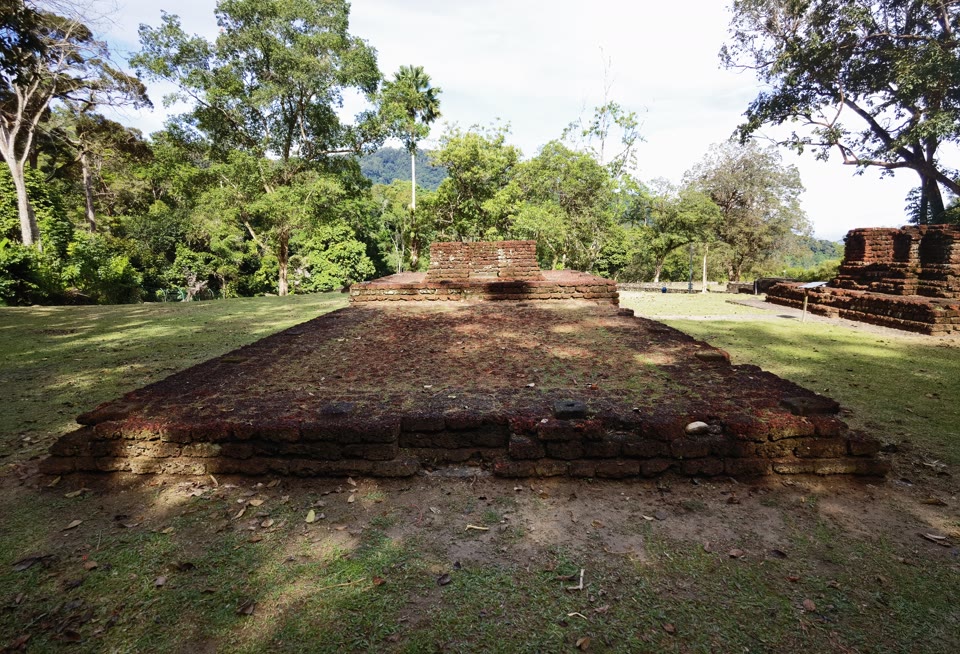
In northern Perak, there is a river valley. Its official name is Lembah Lenggong (Lenggong Valley), listed as a UNESCO World Heritage site in 2012, number 1396, encompassing four sites across two clusters. 7,8
One of the sites is called Kota Tampan. Excavations started in 1978, gradually unearthing a considerable number of stone tools, workbenches, cutting marks, and use wear — an active Paleolithic workshop, where knappers sat to craft the tools they needed.
The age? About 74,000 years ago. 9,7
Seventy-four thousand years ago, someone was knapping stones on the very land beneath our feet. At that time, there was no such thing as "Malaysia," no "Malays," no "Chinese" — not even "Southeast Asia" in its modern sense. But that person was here, using the skills they mastered to do their daily work.
In the same valley, another site is called Gua Gunung Runtuh. During the 1990 to 1991 excavation season, the team discovered a nearly complete human skeleton inside. 8,7
This is Perak Man. Male, roughly in his 40s or 50s, standing about 154 to 157 centimeters tall. A crouched burial — knees bent, laid on his side. Surrounded by stone tools, animal bones, and river shells. 8,7
The age: about 10,000 to 11,000 years ago. 8,7
He is the most complete prehistoric human skeleton unearthed on the Malay Peninsula to date. Public records do not show any published ancient DNA analysis on him — Southeast Asia's hot and humid climate is extremely hostile to DNA preservation, so no one has successfully extracted his genetic information yet. His relationship with any ethnic group today is based purely on morphological inferences, without direct genetic proof. This is the boundary of the archives, and this site will not cross it for anyone.
But this person was here, that much is certain.
Let's Pause Here#
Not to argue about "who came first."
The things on this land — the 74,000-year-old stone tool workshop, the old man sleeping with bent knees from 10,000 years ago, and even the archaeologists and linguists running across the Peninsula recording dozens of languages — these are Malaysia's, belonging to the land beneath our feet.
They are not clubs used to beat anyone; they are something to be collectively proud of.
Two Classification Systems: Official and Linguistic#
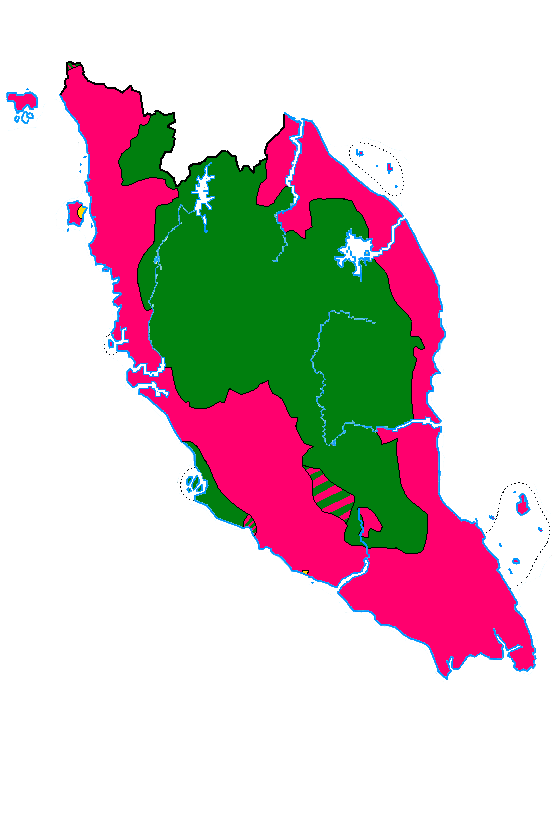
Today, the Malaysian government has an agency called JAKOA (Department of Orang Asli Development), responsible for managing Indigenous affairs on the Peninsula. JAKOA divides the Orang Asli into three main categories, each containing six suku kaum (subgroups), making eighteen groups in total. 10,4
The three main category names are: Negrito, Senoi, and Melayu Proto.
But here is where the official classification mismatches the linguistic one.
The Semelai, classified by JAKOA as "Melayu Proto," actually speak a Southern Aslian language — part of the Austroasiatic family, completely different from the Malay language family. Meanwhile, the Temuan, Jakun, Orang Kanaq, and Orang Seletar, who are also classified as "Melayu Proto," speak dialects of the Malay language branch (Austronesian). 4,10
Put these two tables side by side, and readers can see for themselves: these three administrative categories were drawn by administration, not by language or descent.
This is not to say the categories are "completely wrong" — the over 30,000-year divergence gap between Negritos and Malays is real, not a colonial fiction. But "how the boundary of a category is drawn" is one thing, and "whether this boundary has a natural basis" is another. Both exist; you don't have to pick just one.
How Administrative Labels Make People Disappear#
In the Malacca region, there is essentially only one Indigenous group: the Temuan. 11,12
In 1996, the Temuan made up 98.4% of Malacca's Orang Asli. 12,11
As for today's total: In 2023, there were 1,833 Orang Asli in Malacca. This number comes from only one source — the public dataset on data.gov.my. This site checked JAKOA's official website, and its ethnic groups page only lists scattered populations by settlement, not state-by-state statistics. Therefore, this entry doesn't receive a dual-source tag, stating honestly that it stands on one leg.
However, in the Malay communities of Malacca today, you will encounter a name: Biduanda.
Let's clarify what Biduanda is.
Biduanda is not an independent suku kaum. The name is not on JAKOA's list of eighteen groups. 10,12
Biduanda came about like this: after some Temuan people converted to Islam, they were incorporated into the Adat Perpatih system of Negeri Sembilan, becoming enfranchised members of their respective Luak, thereby acquiring the administrative identity of "Biduanda." The portion of people who remained in the forest and did not convert are still identified as Temuan in JAKOA's files. 10,12
The same group of people, the same origin. A change in administrative label, and they transformed from "Indigenous" into something else.
Classification is an administrative act, not a natural fact.
This sentence is what this entire site is continually demonstrating. The Biduanda of Malacca are one of the smallest and clearest examples of this.
The Johor List#
Down south in Johor, the situation is more complex. In 2023, the total Orang Asli population in Johor was: 15,825; the majority being the Jakun, making up about 45%, distributed across southern Pahang and Johor.
These two numbers, like the Malacca one earlier, only come from data.gov.my. JAKOA's official website lacks state-by-state breakdowns. This is stated honestly, with no dual-source tag attached.
Along the coast are the Orang Seletar, spanning nine villages on Johor's southern shore. Historically, they belong to a branch of the Orang Laut (Sea Nomads). They are classified as Orang Laut in Singapore, but on the Malaysian side, JAKOA categorizes them as Orang Asli — the same group of people, under two different classifications across the straits. 10,11
On the southwestern coast of Johor are the Orang Kuala (Duano'), some of whom call themselves "Orang Melayu Kuala," rejecting the Orang Laut label. 10,11
There is one more name worth noting here: the Orang Kanaq. Living in Kampung Sungai Selangi in the Kota Tinggi district of Johor, their population was only around 130 to over 200 people in 2010, making them the smallest Orang Asli group on the Malay Peninsula. 10,11
An entire ethnic group, numbering a little over a hundred people.
Linguists pay attention to the Orang Kanaq because their language is a branch of Aslian that is dying out. When a language dies, it doesn't just take away vocabulary — it takes away how that community has named this land for thousands of years.
An Older History Lives Inside the Malay Language#
This final note is fascinating.
Linguists studying the sources of Malay vocabulary found a set of words that have no cognates in other Austronesian languages, but do have them in Aslian languages. For example:
- semut (ant)
- ketam (crab)
- cucu (grandchild)
- helang (eagle)
- merak (peacock)
According to Benjamin (2012), these are words borrowed into Malay from Aslian languages. We use them every day without giving a second thought to their origins.
One language contains traces left by an older one. The earlier inhabitants of this land remain present in this way.
Sources 12 Every important claim here can be checked. Open it and see.
Do not trust this site. Check it — every source below is clickable.
-
Search for this source ⌕ no direct link — this button searches for the work 2026-07-30 Report this source
-
Search for this source ⌕ no direct link — this button searches for the work 2026-07-30 Report this source
-
Search for this source ⌕ no direct link — this button searches for the work 2026-07-30 Report this source
-
Search for this source ⌕ no direct link — this button searches for the work 2026-07-30 Report this source
This site is written with AI assistance. Please check us.
AI can invent citations that look completely convincing — a real author's name, a plausible title, a sensible year, for a work that does not exist. This is not a theoretical risk; it is a known failure mode. That is why every source on this site is clickable. If a reference cannot be found anywhere, it may well not exist — and we want to know.
How to check us →
Reader Comments
Be the first to share your thoughts.