The Twenty Points Are Not Twenty Mantras
What Truly Protects Sabah and Sarawak Are Not the Numbers on Commemorative Posters, But Which Demands Entered Reports, Treaties, the Constitution, and Laws
A document that can alter borders is usually remembered by a single sentence.
East Malaysia's document, however, relies on a number.
Twenty.
Today, whenever someone discusses Sabah's rights, the words "Twenty Points" quickly appear. Sarawak also has its own "Eighteen Points." They act like two sets of passwords: supporters believe that as long as the passwords are recited in full, the forgotten door of 1963 can be unlocked; skeptics counter by asking why they are constantly cited if they were not written verbatim under the same headings into the Federal Constitution.1,2,3
Both answers grasp a part of the truth.
And both might miss the most important part.
Because the problem in 1962 was never whether to put twenty sentences into a glass display case. The question was: What powers were North Borneo and Sarawak willing to hand over, and which keys did they insist on keeping in their own hands?1,3,4
A List That Forced the Constitution to Answer, Even if It Wasn't the Constitution#
After the Cobbold Commission left, the conclusion that "a majority of the population accept Malaysia in principle" became the most frequently cited finding by all parties.
But behind the "in principle" in that report trailed a long string of conditions.
Political leaders in North Borneo compiled their anxieties into twenty points; Sarawak formulated a similar eighteen points. They were not a constitution voted on clause-by-clause by the entire population, nor were they twenty annexes to the later Malaysia Agreement. They were, first and foremost, a negotiating stance: before any ink was truly put to paper, someone had to answer these questions.1,2,4
Who controls immigration?
Would the religious arrangements simply copy Malaya's?
How long could English still be used?
Who manages land and forests?
How would indigenous customary laws be preserved?
If Kuala Lumpur wanted to change these arrangements in the future, could the state government say "no"?
The list itself did not automatically become law.
But it forced the law to start working.
Negotiations in Five Rooms#
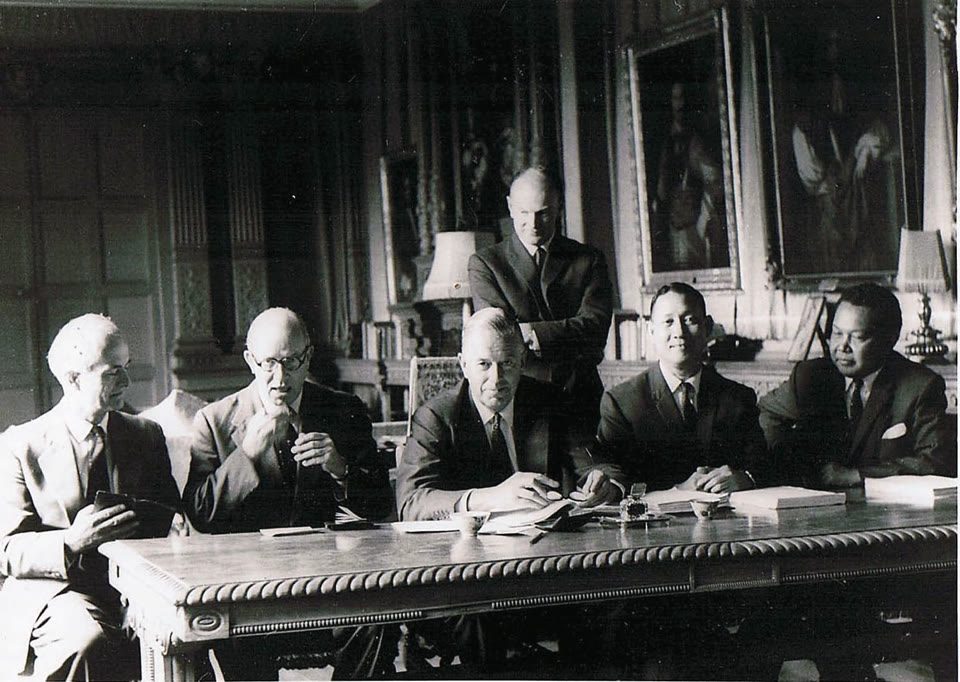
In August 1962, the Inter-Governmental Committee (IGC) was established. Its chairman was Britain's Lord Lansdowne, and its vice-chairman was Tun Razak; representatives from Malaya, North Borneo, and Sarawak sat together in the same institutional design process. The committee was further divided into five sub-committees dealing with constitutional, fiscal, legal, public service, and departmental organization matters.1,3
This was not like a debate on a stage.
It was more like an old government building with five rooms: behind every door, people holding different versions of the future argued over where a word should be placed in a paragraph, and whether a power belonged to the federation or the state.
What the Borneo representatives wanted was not just a sentence saying "We will respect you."
They wanted to turn promises into procedures.
The power of a procedure lies not in sounding moving, but in whether it can block the reaching hand when the next government changes its mind.
The First Key: Who Can Come In#
On the Malayan Peninsula, moving from one state to another usually does not involve facing state-level immigration checks at the airport.
In Sabah and Sarawak, the situation is different.
The Inter-Governmental Committee recommended that although immigration was a federal matter, entry into the Borneo states must be controlled by the state governments; furthermore, specific parts of the relevant laws could not be arbitrarily amended without the state's consent.1,5,2
This is why, decades later, a West Malaysian arriving in Kuching or Kota Kinabalu might still have to present identification at an immigration counter.
That counter is not a historical backdrop.
It is a lock left over from the 1962 negotiations.1,2,3
The anxieties of that time were very specific: would the two less populated territories be quickly overwhelmed by outside populations, officials, and political organizations once the federation was formed? If the movement of people was entirely decided by the center, would the local societies still have time to protect their own employment, land, and political structures?1,3,4
Thus, "joining a larger nation" and "retaining the power to decide who can enter" were simultaneously written into the same set of arrangements.
The Second Key: You Cannot Just Photocopy Malaya#
The issue of religion was particularly sensitive.
The Malayan Constitution already stipulated Islam as the religion of the Federation. But the social structures of North Borneo and Sarawak were different, with Christians, Muslims, and indigenous people holding traditional beliefs living together; many representatives worried that Malaya's system would cross the South China Sea entirely intact.1,3,4
The final arrangement did not delete Article 3 of the Federal Constitution.
But the Inter-Governmental Committee designed different buffers for the two Borneo states: the Head of State would not, by virtue of his office, become the Head of the Islamic religion in the state, and the religious functions of the Yang di-Pertuan Agong would not automatically be transplanted over in the manner of the peninsular states.1,5,2
The same applied to language and education.
The direction of Malay as the national language was not canceled, but the use of English in the legislature, courts, and administration received transitional and special arrangements; changes in education policy could not be completed merely by photocopying the peninsular timetable.1,2,3
Some of these clauses were later changed, some are still visible, and some have become new political controversies.
But together they illustrate one thing: the Malaysia of 1963 was not about stuffing two regions into the mold of 1957.1,5,2
The mold itself had to be cut open anew.
Beneath the Land Lies the Power Most Reluctantly Yielded#
For urban readers, constitutional disputes often take place in meeting halls.
For many indigenous communities, they happen right under their feet.
Land, forests, local governments, native customs, and native courts were viewed as core domains that the states must retain.1,2,4 The Inter-Governmental Committee also recommended that Malaya's Malay Reservation land system not be simply applied, but that corresponding safeguards be established for the local indigenous lands and special status.1,2,4
This was not textual politeness.
Once land rights were lost, local autonomy might be left with nothing but a state flag, a state anthem, and ceremonies.
Precisely because of this, the Federal Constitution later spoke not only of "the Malays" but also had to address the "natives of Sabah and Sarawak" within the relevant frameworks. These two types of safeguards sit adjacent to each other, but they are not the same interchangeable historical experience.1,5,2
Deciding How Many Chairs Are at the Table#
Safeguards are not just about power within the state, but also about how many voices exist in the federal parliament.
The Inter-Governmental Committee recommended that when the new federation was formed, North Borneo would have 16 seats in the House of Representatives, and Sarawak 24 seats. The report also proposed that during the first seven years, their proportion relative to the total number of parliamentary seats should not be reduced without the consent of the state concerned.1,3
The calculation behind the numbers was not complicated.
If the new members had too few seats, the so-called state rights safeguards could be washed away by majority votes during the first major constitutional amendment; if certain key provisions required state consent, the states were not just invited to sit down, but held a part of the power to change the rules of the game.
Therefore, the Inter-Governmental Committee listed a batch of matters that could not easily bypass the state government, including immigration, parliamentary representation, the Borneo High Court, legislative powers, finance, religion, language, and indigenous special status.1,5,2
The "conditions" on the negotiating table began to have door bolts.
So, Do the Twenty Points Have Direct Legal Effect?#
The answer cannot just be "Yes" or "No".
If the question is: **Did the Twenty Points itself, as a treaty named The Twenty-Point Agreement, become the Federal Constitution word for word?**
No.
If the question is: Are the Twenty Points just campaign leaflets that can be thrown into the wastebasket?
Neither.
The more accurate path is: The negotiation demands first entered the Inter-Governmental Committee's discussions; the Committee recommended that through the Malaysia Agreement, relevant acts, the Federal and state constitutions, and subsequent laws, they be transformed into institutions at different levels. The path walked by each point is not completely identical: some were explicitly safeguarded, some were rewritten, some became policy promises, and some were not realized according to the original requests.1,5,2,3
Therefore, the truly rigorous pursuit should not stop at whether "the Twenty Points are still there".
Instead, we should ask item by item:
Into which document did it later go?
Which law carries it now?
Who has the right to amend it?
When amended, did it obtain the consent that was originally required?
This is much more troublesome than just memorizing twenty titles.
And it is also much more powerful than just memorizing them.
Evidence for This Article, Clearly Explained#
This article does not masquerade the Twenty or Eighteen Points as verbatim annexes to MA63. The historical role of the two lists is cross-referenced using the Cobbold Report, the IGC Report, and legal research; specific legal safeguards are based on the IGC and MA63 document chain.1,5,2,4
The arrangements regarding immigration, religion, language, land, representation, and state consent are all drawn from the original IGC text. This article only selects the parts that best explain the institutional differences, and does not claim to list every subsequent legal amendment and precedent.1,5,3
This article is sensitive: true. The relationship between the Twenty Points, Eighteen Points, and MA63 remains a realistic political and legal controversy; the original draft was reviewed line by line by Jay before publication.
Next up: The terms were finally written into the documents, but people could not celebrate yet. The nation, originally scheduled to be born on August 31, did not appear on that day—it still had to wait another sixteen days.
Sources 5 Every important claim here can be checked. Open it and see.
Do not trust this site. Check it — every source below is clickable.
This site is written with AI assistance. Please check us.
AI can invent citations that look completely convincing — a real author's name, a plausible title, a sensible year, for a work that does not exist. This is not a theoretical risk; it is a known failure mode. That is why every source on this site is clickable. If a reference cannot be found anywhere, it may well not exist — and we want to know.
How to check us →
Reader Comments
Be the first to share your thoughts.