Where Did the Name Melayu Come From?
The first time the name "Melayu" was recorded in writing, it did not refer to an ethnicity — it referred to a place by a river in Sumatra
Today, in Malaysia, some people say this: this land is called "Tanah Melayu" — the Land of the Malays — so it belongs to the Malays.
Hidden inside that sentence is a leap: from a name, straight to ownership.
But if you actually trace where this name came from, you'll find its roots are older and stranger than any claim of sovereignty. The first time this word was ever set down in writing, it was not on the Malay Peninsula, not in any dynastic history, and not on any stone inscription. It appeared in the travel notes of a passing foreign monk — and at that moment he wasn't recording an ethnicity, he was recording where a ship was going.
More surprising still: scholars have spent a century arguing over where the word "Melayu" itself came from. Some say it is the name of a mountain in southern India, some say it is the name of a river in Sumatra, and others say it means "to flee" in Javanese. Each theory has its evidence, and each has its holes. 1,2
A name cannot hold a land title. But the road this name has traveled is itself a piece of history.
In 671, a merchant ship was waiting for the wind.
At that time, there was no other way. If a ship wanted to sail south, it had to wait for the northeast monsoon; if the wind didn't blow, people just sat in the harbor, counting the days. The ship was loaded with goods to be sold down south, and it also carried a few monks.
One of those monks, we later came to know as Yijing (I Ching). He wanted to go to India to obtain Buddhist scriptures.
Many people had traveled this path, but few returned.
Finally, the wind came.
The First Stop: A Buddhist Hub#
The ship sailed straight south, entered the straits, and stopped at a place called Srivijaya.
Yijing stayed there for six months. 3,4
He wasn't stranded. He intentionally stayed — the place had temples, a monk community, and Sanskrit could be studied there. He was heading to India to read scriptures, so he needed to sharpen his tools here first.
A Chinese monk on his way to India stopping in Sumatra for six months to study — this fact alone shows what this sea looked like at the time: it was not merely an empty stretch of water to be crossed, it had its own centres of learning.
The Second Stop: Switching Ships#
Six months later, Yijing moved on. The next stop was a place called Melayu. 3,4
There is a detail here worth noting.
Another monk who set out with him, named Wuxing, went to Melayu on the king's own ship — departing from Srivijaya and sailing for fifteen days. 3,7
Fifteen days. A special ship had to be arranged.
This means: in 671, Melayu and Srivijaya were two different places, separated by a fifteen-day voyage, each with its own king, and each with its own port.
Remember this point. It will become very important later.
That Name#
Melayu.
Written in Chinese with three characters, it is pronounced Mo-lo-yu.
Say it again, slowly — Melayu.
This is the earliest known written record of this name. 3,4 It is not found on the Peninsula, not in any dynastic history, and not on any stone inscription. It appeared in the travel notes of a passing foreign monk.
And what he wrote down was not "I met a group of Malay people."
What he recorded was "the ship went to a place called Melayu" — the same way you might say a ship went to Penang.
It was the name of a place, not the name of an ethnicity.
Where Was That Place?#
Not on the Malay Peninsula.
Two unrelated scholars, taking two entirely different paths, arrived at the same answer. One approached it directly through the official Chinese histories and Yijing's original texts, while the other started from epigraphy — both placed Melayu around Jambi on the southeastern coast of Sumatra, in the Batanghari River basin. 7,4
Traced one step further, which ruins specifically? It usually points to the cluster of temple ruins at Muara Jambi. 8,4
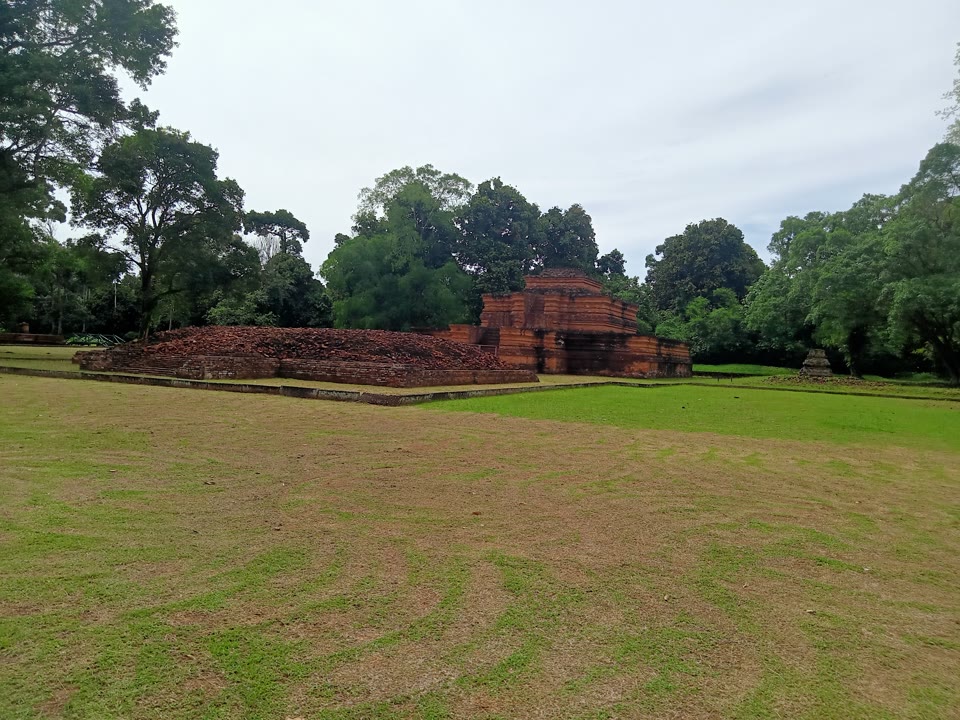
This step needs to be made clear: going from "around Jambi" to "specifically the Muara Jambi temples" is an identification, not a land grant. There is no inscription at the site reading "Melayu was here." This site states its level of certainty precisely:
- In Sumatra — Solid. Two independent scholarly paths agree.
- Around Jambi — Solid. As above.
- Specifically the Muara Jambi temples — The mainstream view, but an assumption.
One more side note: the next stop after Yijing left Melayu was called Kacha — today's Kedah. 3,4 He also passed through the Peninsula. What was later found there is a story for another article.
Fourteen Years Later, He Passed By Again#
Yijing traveled around the South Seas and India for over twenty years. In 685, on his way home, he stopped briefly again at Kedah and Melayu. 3,4
Then he continued north, and returned to China in 695.
Once back, he sat down and spent more than twenty years compiling his observations into a book.
When writing about Melayu, he added a note.
The meaning of that note was: it has now changed its name to Srivijaya. 3,7
A Death Certificate#
That sentence is very short and plain, a quick addition by the chronicler — meant to stop readers from searching under the old name and ending up in the wrong place.
But think back to that detail of the fifteen days.
In 671, Melayu and Srivijaya were two countries, separated by fifteen days at sea.
By the time Yijing wrote his book, only one remained.
Yijing never wrote about how it was swallowed up. He may not have known, or he may have felt it wasn't his place to record it. He simply updated the name.
A country vanished inside a footnote.
As for exactly when the merger happened — some say the late seventh century, others push it back to the early 680s. Neither figure comes from a date on any inscription; both are estimates scholars have worked backward from Yijing's text. This is a deduction, not a record. This site makes no ruling on it.
The Country That Swallowed It#
Srivijaya — also rendered as Sanfoqi in Chinese historical sources.
It was a maritime power that controlled the Strait of Malacca from the seventh to the eleventh century. It did not rely on territorial expansion; it relied on collecting tolls: passing merchant ships had to go through its waters, and so it took its cut.
Its capital stood at Palembang.
This is not a conclusion drawn from books. From 1988 to 1990, a team of archaeologists spent three years digging along the Musi River in Palembang — from Bukit Seguntang all the way to Sabokingking — pulling this capital out of the ground. 6,4
Before that excavation, "whether Palembang was the capital of Srivijaya" was still an open question. After it, the question was more or less settled.
The Stone by the River#
About twelve years after Yijing first passed through this sea — in 683 — on the bank of a river outside the city of Palembang, someone erected a stone.
Words were carved into it. The script was Pallava, which came from southern India.
But the language recorded by that script was not Sanskrit.
This is one of the earliest known Old Malay inscriptions with a clear date. It was not on the Peninsula, not in Kedah, and not in Terengganu. It stood on the bank of a river on the outskirts of Palembang.
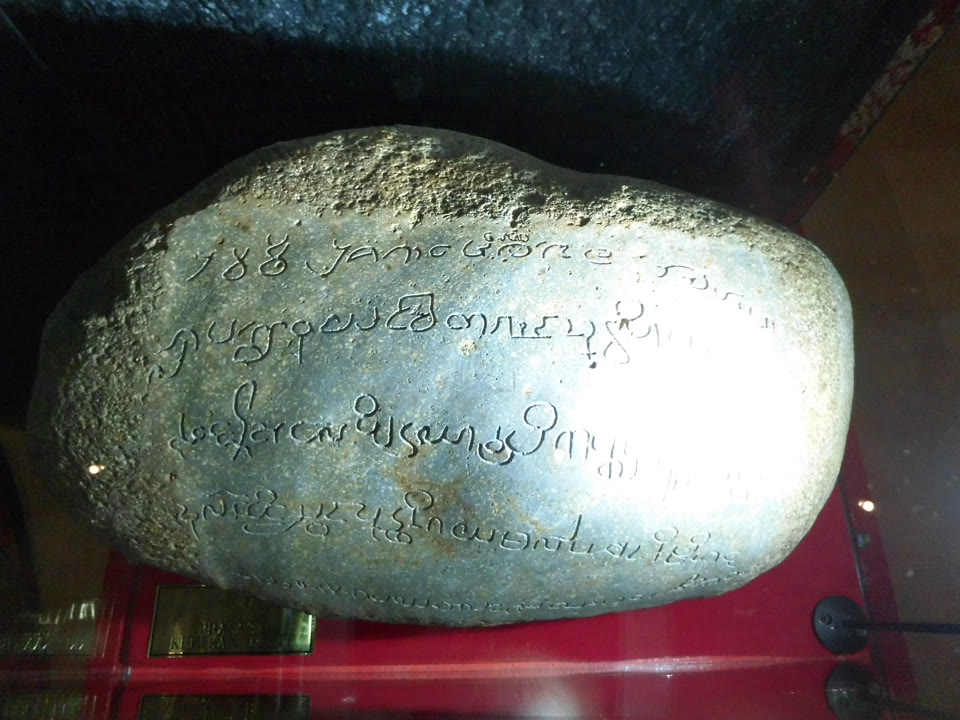
What was written on that stone?
That is a story for the next article.
Two Theories on Where the Word "Melayu" Came From#
When Yijing recorded this name, he never explained what it meant. He simply noted a place name.
Thirteen hundred years later, scholars are still arguing over where the word actually came from. For now there are two paths, each with evidence, and each with holes.
The First Theory: It Is the Word for "Mountain"#
In the mid-twentieth century, a scholar teaching at Nanyang University, Joseph Minattur, published an article titled "Malaya: What's in the Name?" His argument was this: Malaya is a Sanskrit word, derived from the Dravidian mala (mountain, hill), originally used for a mountain range along the southwestern coast of India — today's Kerala region. 2,1
This was not merely a theory on paper. Minattur found that on the island of Sumatra, there still exists, to this day, a mountain, a river, and four villages all named Malaya. 2,1
Further still: the Tanjore inscription of the Chola empire, from the eleventh century, recording the conquests of Chola forces across various places in Southeast Asia, mentions a place called "Malaiyur." The word is quite transparent in Tamil: malai (mountain) + ur (town) = "mountain town." 2,1
Andaya, in his 2001 article, also cites an earlier, similar theory from the Dutch scholar Rouffaer — Rouffaer likewise argued that Malaiyur came from the Tamil meaning "mountain town," and went so far as to declare that both Tamils and Malays regarded Jambi as the "original homeland of the Malays." 1,2
But Andaya also notes, in a footnote, that Rouffaer's claim was not backed by any primary source material. 1,2
The credibility of the mountain theory rests on this: Sanskrit and Tamil records of mountains had indeed entered the place-naming systems of Southeast Asia — the very name of the Sailendra dynasty is a Sanskrit rendering of the Tamil "mountain king" (mala-arayar). 2,1 But the weakness of the mountain theory is just as plain: there is a gap between "this area has a mountain" and "so the place was named for a mountain" — no source directly links the two.
The Second Theory: It Is a River, a Place#
Meanwhile, another group of scholars took an entirely different route. They didn't ask about the root of the word — they asked: where does Melayu first appear in the earliest sources?
As mentioned earlier, the Melayu recorded by Yijing in 671 was placed, by two scholars taking entirely different scholarly paths — Wolters through the official Chinese histories, Coedès through epigraphy — both around Jambi on the southeastern coast of Sumatra, in the Batanghari River basin. 7,4
Twenty-seven years before Yijing, the Chinese chronicles (the Jiu Tangshu and related records) recorded an event: in 644, a place called Melayu sent envoys to present tribute to the Tang dynasty. 1,3 This is the earliest known written record of "Melayu" — not Yijing, but a diplomatic document, and what it records is a local polity sending gifts to China, not an ethnicity.
Andaya also draws attention to one particular detail: in the Jambi area there is indeed a river called the Melayu River. In Javanese and Mandailing, melayu carries the meaning "to move swiftly," and this river is said to be known for its fast current, from which it supposedly took its name. If this holds, then the origin of "Melayu" would not be a mountain but a fast-flowing river: the name of a people would come from the name of a place, and the name of a place would come from the nature of the water itself. 1,2
Of course, this too remains an assumption — there is no clear source that states outright "Melayu was named for its swift current." Andaya himself acknowledges that this chain of inference rests only on linguistic evidence, with no direct link from any source material.
Andaya's overall conclusion is this: Malay identity first took shape along the southeastern coast of Sumatra and along the Strait of Melaka, beginning around the seventh century. Not a word for mountain in the linguistic sense, and not "to flee" in the mythical sense, but a settlement name that genuinely existed within an international trading network, which slowly grew into a cultural label. 1,4
One more theory is worth mentioning, though it reads more like literature than history: the Portuguese chronicler Tomé Pires, in his early-sixteenth-century book Suma Oriental, records that the founder of Melaka, Parameswara, explained that "one who flees is called Malayo" — "to flee" in Javanese and Mandailing does indeed carry the word melayu. This theory has strong literary appeal, but the way it was transmitted is questionable: its only source is the account of a sixteenth-century Portuguese diplomat, with no independent material to confirm it. 9,1
Weighing the Two Theories#
| Mountain-Town Theory (Tamil/Sanskrit) | Place-Name/Settlement Theory (Sumatra) | |
|---|---|---|
| Main sources | Minattur 1966; Rouffaer 1921 | Andaya 2001; Wolters 1967; Coedès 1968 |
| Type of evidence | Linguistic comparison + place names on inscriptions | Chinese historical sources + epigraphy + Yijing's travel notes |
| Biggest gap | No direct source links "mountain" to "Melayu" | Cannot explain the literal original meaning of the root word itself |
| Mainstream view | A minority theory, but not fully rejected | The framework more widely held by historians today |
The two theories are actually answering questions pitched at different levels: the mountain-town theory asks "what did this word literally mean"; the settlement theory asks "how did this name first come into use." Both questions can have answers, and those answers need not contradict each other — it is entirely possible that the place was originally named for a mountain or a mountain-town, and that name later spread through the trading world and turned into the label for a political community.
How Other Civilisations Named This Land#
"Melayu" is one name. But this land, in different eras, was called by different names by different visitors — this was never the only name it had.
These names, in themselves, form a map of an early globalisation.
A Name from the West: The Golden Peninsula#
Around 150 AD, a scholar in Alexandria, Egypt, named Claudius Ptolemaeus (Ptolemy), was compiling the geographical knowledge of those before him. In his work, the Geographike Hyphegesis, he named the large region south of today's Malay Peninsula Aurea Chersonesus — Latin, meaning "the Golden Peninsula" (Chersonesus = peninsula; Aurea = golden). 9,2
Today, this work carries the English title The Golden Khersonese. Paul Wheatley used it in 1961 as the title of his own study of the historical geography of the Malay Peninsula, and that title is still in use today. 9,2
Where did the "gold" come from? This is most likely a Greek rendering of the Sanskrit Suvarnabhumi (Land of Gold) or Suvarnadvipa (Island of Gold). Both Sanskrit terms appear in ancient Indian sources, referring to the legendary land of gold mines — that is, Southeast Asia. 9,2
A Name from India: The Land of Gold#
Sailors of the Indian Ocean reached this region even earlier than the Greeks. In Sanskrit sources, the terms used to describe the trading region of Southeast Asia were Suvarnabhumi (Land of Gold) and Suvarnadvipa (Island of Gold) — but both terms refer to a rather vague area: sometimes the peninsula, sometimes Sumatra, and possibly even the whole Southeast Asian coastline in general. 9,2 Scholarly consensus holds that both terms were simply the ancient Indian traders' general name for "the place in the east where gold and spices could be found," not a precise place name. Equating either term directly with "the Malay Peninsula" is a common misreading.
Tamil traders from southern India knew the Kedah region in the northwest of the peninsula quite well, and called it Kataha or Kadaram. Wheatley, in his work, catalogued these place names one by one, and found that from the fifth to the eleventh century, the Kedah region was an important stopover for Indian ships. 9,4
A Name from China: Following the Tribute Records#
Since the Han and Tang dynasties, Chinese historical records kept a scattering of place names on the peninsula, but they were dispersed and unsystematic.
The one most relevant to this article is this: in 644, a polity called Melayu (Mo-lo-yu) sent envoys to present tribute to the Tang dynasty. This is the earliest known written record of "Melayu." 1,3 After that, Yijing mentioned Melayu again in his travel notes in 671.
Along the northeastern coast of the peninsula, other place names mentioned in Chinese sources between the third and seventh centuries include: Chitu (Red Earth, possibly in the upper reaches of today's Kelantan River), Panpan (possibly in Kelantan or Terengganu), and Dunsun. 9,1 Andaya argues that these records describe city-states with an Indian cultural colouring, and that at the time their ties to China were far looser than their ties to the trading network of the Indian Ocean. 1,9
A Name from the Arabs and Persians: Zabag and Kalah#
Around the ninth century, Arab and Persian seafaring traders had their own names for the region too.
The Persian geographer Abu Said (around 916 AD) called the ruler of a great maritime power the "Maharaja of Zabag," and placed his territory around Sumatra and Java. 1,4 The Arab historian Masudi (943) repeated this account. "Zabag" is most likely an Arabic transliteration of Srivijaya. 1,9
As for the Malay Peninsula itself, the peninsular port name that appears most often in Arab and Tamil sources is Kalah or Kadaram, and scholars tend to place it around the mouth of the Merbok River in today's Kedah, or further north at Takuapa. 9,1 These places were important stops on Arab shipping routes, and phrases like "change ships at Kalah for India" were common in the travel accounts of the time.
When Did "Semenanjung Tanah Melayu" Come Into Use?#
The name we take for granted today actually appeared quite late.
Before the fifteenth century, "Melayu" referred only to settlements in Sumatra; the peninsula was not called "Tanah Melayu." 1,4 Calling the peninsula "Tanah Melayu" — the Land of the Malays — first appears in Malay literary texts from the fifteenth to seventeenth centuries, most notably the Hikayat Hang Tuah — but that was after the founding of the Melaka Sultanate, an expression that slowly took shape through debates over "who is truly the centre of the Malay world." 1,9
It was only after the British colonial administration entered the peninsula that this name was fixed as the standard term in administration and on maps. 1,9
In other words: the name "Tanah Melayu" itself was already the product of a political contest — not its starting point.
Sources 9 Every important claim here can be checked. Open it and see.
Do not trust this site. Check it — every source below is clickable.
-
View excerpt ↓
Based on linguistic, archaeological, and historical evidence, this essay describes the environment that produced the culture associated with the 'Melayu', or the Malays. It also argues that Melayu ethnicity was never predetermined but was contested on both sides of the Straits of Melaka.
-
Search for this source ⌕ no direct link — this button searches for the work 2026-07-30 Report this source
-
Search for this source ⌕ no direct link — this button searches for the work 2026-07-30 Report this source
-
Search for this source ⌕ no direct link — this button searches for the work 2026-07-30 Report this source
-
View excerpt ↓
In 1918, the French epigraphist George Coedès finally identified Fo-Che or San-fo-ts'i as the kingdom of Srivijaya centered in Palembang, Sumatra.
This site is written with AI assistance. Please check us.
AI can invent citations that look completely convincing — a real author's name, a plausible title, a sensible year, for a work that does not exist. This is not a theoretical risk; it is a known failure mode. That is why every source on this site is clickable. If a reference cannot be found anywhere, it may well not exist — and we want to know.
How to check us →
Reader Comments
Be the first to share your thoughts.