What Happened in the 1990 General Election?
1990 General Election —— Tengku Razaleigh Exits with the Other Half of the Old UMNO
Forty-three votes.
On April 24, 1987, UMNO delegates dropped their ballots into the boxes. When the counting was over, Mahathir obtained 761 votes, and Tengku Razaleigh received 718. 1,2,3,4
If just twenty-two votes had switched sides, the winner would have been reversed.
But no sides were switched.
Mahathir remained the President of UMNO and continued to serve as Prime Minister.
Tengku Razaleigh did not accept that the contest was over. The party election dispute went to court, and the old UMNO was subsequently declared an unlawful society by the High Court due to the existence of unregistered branches. Mahathir's faction formed UMNO Baru; Tengku Razaleigh's faction first tried to restore the old party, and after failing, formed Semangat 46. 1,2,3,4
Those forty-three votes were never recounted.
Instead, they turned into another national election within three years.
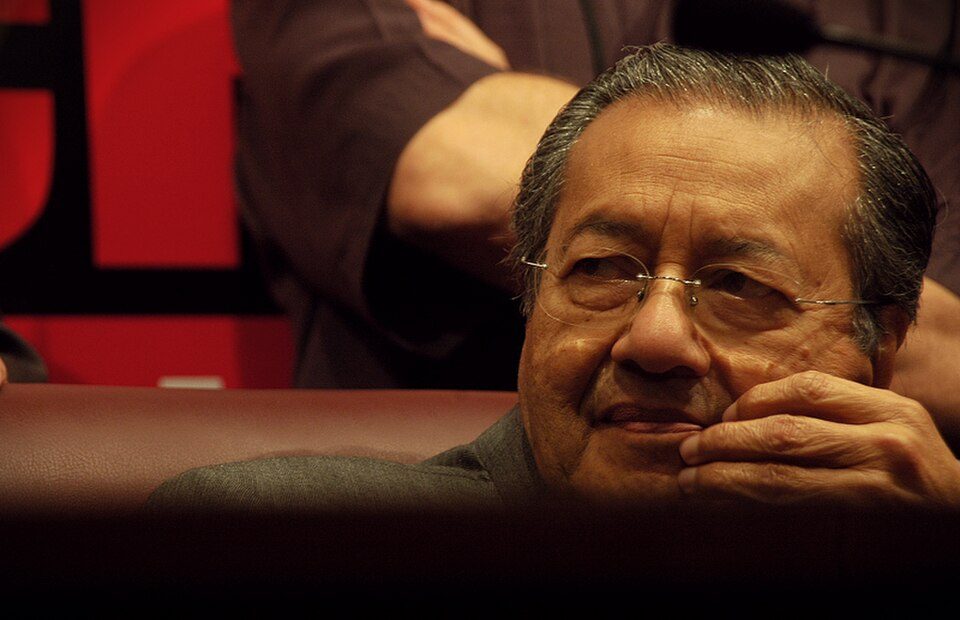
A number, to reclaim a name#
The "46" in Semangat 46 points to the year 1946.
That was the year the old UMNO was founded.
The name itself was a political statement: Mahathir could register the new UMNO, but Tengku Razaleigh wanted to tell the original members that the spirit of the old UMNO did not necessarily transfer over along with the registration certificate.
Semangat 46 was approved as a political party in 1989. After going through hurdles with its application and party symbol, it finally used "46" as its most prominent identifier; many former ministers, state leaders, and party cadres who belonged to Tengku Razaleigh's camp joined. 1,2,3
But "the old party splitting in half" should not be taken literally.
The party delegates in 1987 took sides almost equally, and some early by-elections also showed signs of a near-even split in the Malay vote; this did not mean that exactly half of the old UMNO members nationwide joined the new party. The incumbency resources were still in the hands of UMNO Baru, and some of those who originally supported the challenger quickly returned to the side that held power. 1,2
Tengku Razaleigh thus faced a question more difficult than registering a new party:
After leaving UMNO, where would he find enough allies?
The answer lay between two names that were previously hard to seat at the same table.
PAS.
DAP.
If they can't sit at the same table, set up two tables#
Tengku Razaleigh had long fought against PAS within UMNO.
DAP and PAS also had stark differences in their imagination of the nation, religion, and the law. If all three were forced into a single coalition, internal disputes might have flipped the table before the campaign even started. 1,2
Therefore, Semangat 46 set up two tables.
The first table was called Angkatan Perpaduan Ummah, or APU. Semangat 46 coordinated seats with PAS, BERJASA, HAMIM, and other parties that targeted Malay Muslim voters to avoid splitting votes in the same constituencies. 1,2,4
The second table was called Gagasan Rakyat. Semangat 46 collaborated with DAP, Parti Rakyat Malaysia, and some smaller parties to try and prove to urban and non-Malay voters: the opposition camp was not just a few parties guarding their own corners, but could potentially form an alternative government. 1,2,5
Sitting between the two tables was the same Semangat 46.
This arrangement was brilliant, yet fragile.
Its brilliance lay in the fact that PAS did not have to publicly become DAP's ally, nor did DAP have to endorse all of PAS's agendas; both sides could still coordinate candidates through Semangat 46, turning more constituencies into one-on-one contests between the ruling coalition and the opposition camp. 1,2
Its fragility was that voters would ask:
If they really win, which table calls the shots?
Was a party extending its hands to both PAS and DAP simultaneously building a bridge across differences, or temporarily hiding unresolvable contradictions under the bridge?
Before this question could be answered, Sabah suddenly pushed the entire election toward another possibility.
Five days before polling, PBS leaves BN#
The campaign period in 1990 was only ten days long.
On October 15, with only six days left before polling in the Peninsula, the ruling Parti Bersatu Sabah (PBS) in the Sabah state government announced its withdrawal from Barisan Nasional and switched to the opposition camp. The Commonwealth Observer Group's records confirmed the date of the pullout; reports at the time described the move as a shockwave that occurred in the final stages of the campaign. 1,2,5,6
PBS was not just a statement.
It had just defended the state government in the Sabah state election and held a bloc of parliamentary seats. After PBS switched sides, the opposition camp was no longer just a temporary collaboration of peninsular parties; it suddenly seemed to have an existing state government, an East Malaysian base, and a map much closer to what was needed to rule. 1,2,7,8
PBS leaders believed that the federal government had long failed to adequately respond to Sabah's demands regarding oil rights, immigration, education, television services, and federal-state relations. Tengku Razaleigh offered them another negotiating counterpart. 2,8
Mahathir called PBS's withdrawal a stab in the back.
From Barisan Nasional's perspective, this anger was easy to understand: nominations had been completed, and PBS candidates had originally entered the campaign as members of the ruling coalition, only for the party to switch to the opponent just before voters cast their ballots. 1,2,5,8
From PBS's perspective, they were betting on another outcome:
If a change of government really happened, Sabah did not want to take sides at the last minute.
But at the last minute, it is also easiest for a single photograph to overshadow all policies.
That headdress#
When Tengku Razaleigh arrived in Kota Kinabalu, he was presented with a traditional Kadazan headdress, the sigah.
He put it on.
The photograph was taken.
The pattern on the front of the headdress looked like a cross. The photograph quickly appeared in Malay newspapers, on television screens, and in a massive number of leaflets, and was connected to a highly damaging accusation: in order to cooperate with PBS, Tengku Razaleigh had sacrificed the interests of the Malays and Islam. 1,2,6,8
To many Sabahans, it was primarily a piece of traditional clothing.
Herman Luping, who was involved in Sabah politics, later explained that the pattern represented the four corners of the compass (north, south, east, and west), not a Christian cross. But an image in a campaign does not wait for cultural explanations to be completed; it only needs to trigger associations in the viewer's mind within seconds. 2,8
How many votes were actually shifted by this photograph, public records do not have an answer.
There is no reliable post-election survey that can isolate economic performance, candidates, local organisation, incumbency resources, fear of instability, and the dissemination of the headdress photograph one by one, and tell us how many voters each factor moved.
Scholar Crouch noted that the opposition camp believed the photograph swayed many Malay voters in the final stretch; Aliran from the same period also argued that the mainstream media quickly turned the PBS pullout into an ethnic and religious threat. The Commonwealth Observer Group did not rule on the effect of a single photograph, but explicitly recorded that television and mainstream media were overwhelmingly biased towards the government, and opposition parties could not get equal access to electronic media. 1,5,6
Therefore, what history can confirm is not "this photograph won the general election."
What can be confirmed is this:
While policy debates were still explaining how the two coalitions would govern together, a piece of headwear had rewritten the question into "who is protecting your community."
A complex coalition takes many minutes to explain.
Fear only needs a single photograph.
No national upset, but the map cracked#
On October 20 and 21, the ballots gave their answer.
Barisan Nasional won 127 out of 180 parliamentary seats, not only remaining in power but also keeping its two-thirds majority. Semangat 46 won only 8 of the 61 parliamentary seats it contested; DAP won 20 seats, PAS 7, PBS 14, and 4 independent candidates were also victorious. 1,2,4,7
This was not a "narrowly defended power."
This was a clear victory.
However, painting the national results in a single colour would also mean missing the cracks on the map.
In Kelantan, APU won all 13 parliamentary seats and swept all 39 state assembly seats. PAS took 24 state seats, Semangat 46 took 15, and BN was left with none. 1,2,4
In Sabah, the newly departed PBS won all 14 parliamentary seats it contested. 2,7
In Penang, DAP leader Lim Kit Siang defeated long-serving Chief Minister Lim Chong Eu; DAP was only a few seats short of a majority in the state assembly but could not form the government because its Malay partners failed to win the necessary constituencies. 1,2
The result, therefore, was not a simple "BN won, opposition lost."
BN won the national government.
APU won Kelantan.
PBS held Sabah.
DAP achieved strong results in certain urban and Chinese-majority constituencies.
The one that truly fell short of expectations was Semangat 46 itself. It was supposed to be the bridge between the two opposition coalitions and prove itself more qualified than UMNO Baru to inherit the old UMNO; yet the ballot boxes showed that aside from Tengku Razaleigh's home state of Kelantan, the party failed to translate a near-half split within the party into a near-half split among Malay voters nationwide. 1,2
Forty-three votes were enough to crack a party.
But it was not enough to topple a ruling system that already controlled the government, the media, local organisations, and distribution networks.
Why the closest attempt was still not close enough#
Barisan Nasional's victory cannot be explained solely by the headdress photograph.
With the economic recovery in the late 1980s and improvements in investment and employment, BN made peace, stability, and prosperity its main campaign themes. For voters who had experienced an economic recession, party strifes, Operation Lalang, and a judicial crisis, continued growth itself was a weighty reason. 1,2,7
Incumbency advantage also could not be ruled out.
The Commonwealth Observer Group found that television coverage of campaign news was almost exclusively given to ministers, while opposition parties were not granted equal opportunities to present their figures and policies. Crouch pointed out that a segment of the old UMNO supporters who relied on government licenses, loans, contracts, land, or administrative connections gradually returned to the side holding power between 1989 and 1990. 1,2,5
The opposition camp also had its own structural problems.
It successfully coordinated many constituencies but failed to form a truly unified political platform. The distrust between PAS and DAP did not disappear; it was merely kept apart temporarily by Semangat 46. Moreover, PBS joined in the final stages of the campaign, leaving too little time for peninsular voters to understand what role their East Malaysian partner would play in a coalition government. 1,2
Thus, the opposition camp of 1990 already looked like an alternative coalition.
But they had not yet learned to answer questions like a coalition.
The evidence for this piece, which we must explain to you#
"Forty-three votes" refers to party delegate votes, not national popular votes. It proves that UMNO's top leadership and general assembly were deeply divided, but one cannot directly infer that half the party members or half the Malay voters nationwide supported Tengku Razaleigh. Therefore, this site altered the original subtitle, no longer stating he "exited with half of the old UMNO." 1,2,3,4
"Two opposition fronts" were not a complete coalition. Semangat 46 participated in APU and Gagasan Rakyat at the same time, but PAS and DAP did not jointly enter the same organisation. This article refers to it as a bridge and the prototype of an alternative coalition, and does not backward-engineer it as a unified party coalition like those in the future. 1,2,5
The headdress was indeed photographed and disseminated, but its religious implications cannot be treated as fact just as campaign propaganda portrayed. Academic research and contemporary publications confirm the photograph was widely used; the explanation from those involved in Sabah was that the pattern represented the four directions. This article only states the pattern "looked like a cross" and how it was exploited at the time, not that Tengku Razaleigh wore a Christian symbol. 1,2,6,8
There is no precise evidence on how many votes the photograph shifted. Crouch noted the opposition believed it affected the final voting stages, and Aliran also highlighted the propaganda effect; this is still not a poll or experiment that controls for other factors. The article thus refrains from using "the photograph that won the general election" as a definitive causal link. 1,6
BN did not scrape by to form the cabinet. 127 seats were enough to continue governing and retain a two-thirds majority. The tension existed in pre-election forecasts and local battlegrounds; ultimately, the national result was a clear BN victory. 1,2,4,7
This piece is marked sensitive: true. Before going online, sentences involving UMNO, Semangat 46, PAS, DAP, PBS, religious campaigning, media bias, and ethnic voting must be reviewed word-by-word by Jay.
Next up: Mahathir did more than just defend the federal government. While the opposition camp was still counting the reasons for their defeat, he began talking about a much longer timeline. Four months later, a speech at the Business Council etched a year into the minds of the entire nation: 2020. 2,9
Sources 9 Every important claim here can be checked. Open it and see.
Do not trust this site. Check it — every source below is clickable.
This site is written with AI assistance. Please check us.
AI can invent citations that look completely convincing — a real author's name, a plausible title, a sensible year, for a work that does not exist. This is not a theoretical risk; it is a known failure mode. That is why every source on this site is clickable. If a reference cannot be found anywhere, it may well not exist — and we want to know.
How to check us →
Reader Comments
Be the first to share your thoughts.