HINDRAF Rally: Was the Memorandum Delivered?
Gandhi portraits, low-flying helicopters, and the wounds of the Indian community finally breaking into national view
"Brother, has the memorandum been delivered?"
The Malaysian Bar's monitoring report noted that a young man approached a police officer and asked this question in Malay.
The police officer did not answer. 1,2
On the early morning of 25 November 2007, the crowd originally intended to deliver a petition to the British High Commission. Along the way, there were portraits of Gandhi, banners reading "We are Malaysians, We want our rights," as well as low-flying helicopters, water cannons, and waves of tear gas. 1,2
Not a Sequel to the Yellow Rally#
Fifteen days earlier, BERSIH talked about the electoral system.
What HINDRAF brought to the streets was another set of issues that had accumulated for years within the Indian community: resources for Tamil primary schools, grassroots employment and poverty, statelessness and lack of identity cards, the demolition of Hindu temples, and anxieties triggered by religious conversions and family law. 1,3
These injuries did not fall evenly across the three major ethnic groups.
They were significantly concentrated in the Indian community, especially among lower-income Tamil Hindus. Acknowledging this asymmetry does not mean every Indian supported HINDRAF, nor does it mean all Indians are Hindus; it is a refusal to use a blanket "everyone is struggling equally" narrative to flatten specific historical grievances. 1,3
Observers estimated that there were at least ten thousand people present, while other reliable sources provided a range of 10,000 to 30,000. The crowd was largely peaceful, though reports also noted some individuals throwing tear gas canisters back at the police. Insufficient organization, blocked routes, and continuous dispersals made the scene increasingly chaotic. 1,2

A Crack Appears Before MIC's Door#
For a long time, Barisan Nasional relied on MIC to demonstrate its representation of the Indian community. The political challenge posed by HINDRAF was not "do Indians have a minister," but rather: given that there are ministers, MPs, and a political party, why did issues of temples, schools, identity documents, and grassroots survival still accumulate such intense dissatisfaction?
In December, five HINDRAF leaders were detained without trial under the Internal Security Act (ISA). The government called it a security measure; Amnesty International considered the detention essentially a punishment for expressing the community's marginalized grievances. 2,4
The detention suppressed the organization's leaders, but it did not answer MIC's crisis of representation.
A little over three months later, voters entered the polling stations. By then, the institutional questions raised by the yellow rally, the community wounds brought forth by HINDRAF, the cost of living, judicial controversies, and delayed reform promises would all converge behind the ballot paper.
None of these single factors alone could explain the subsequent results.
But the results would make a ruling coalition realize for the first time that the seemingly eternal two-thirds wall could also lose eight chairs.
Sources 4 Every important claim here can be checked. Open it and see.
Do not trust this site. Check it — every source below is clickable.
This site is written with AI assistance. Please check us.
AI can invent citations that look completely convincing — a real author's name, a plausible title, a sensible year, for a work that does not exist. This is not a theoretical risk; it is a known failure mode. That is why every source on this site is clickable. If a reference cannot be found anywhere, it may well not exist — and we want to know.
How to check us →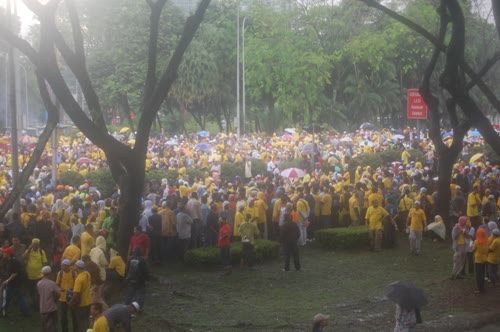
Reader Comments
Be the first to share your thoughts.