Why Did BERSIH March to the Palace?
A human chain, a memorandum, and water cannons crossing the gap outside Masjid Jamek
Outside Masjid Jamek, volunteers from PAS's Unit Amal linked arms, forming a human chain.
On one side was the crowd dressed in yellow.
On the other side was the Federal Reserve Unit (FRU).
Observers from the Malaysian Bar recorded that they saw no active provocation from the crowd, nor did they hear prior warnings; subsequently, chemical-laced water cannons and tear gas crossed the gap between the two sides. 1,2
On 10 November 2007, reform stepped out of the report books and onto the streets.
Four Demands That Didn't Sound Heroic#
At the time, BERSIH demanded the cleanup of the electoral roll, the use of indelible ink, the prevention of postal voting abuse, and fair media access for all parties. 3,1
None of them sounded like a slogan to overthrow the government.
They were talking about whether names were duplicated, whether a finger could prove a vote had been cast, who could vote by post, and to whom television cameras were willing to point. These technical details, however, determine how heavy a ballot is before it enters the ballot box.
Participants moved from different locations such as Sogo, the National Mosque, Central Market, and Masjid Jamek. Roads were blocked, but the crowd still converged toward the National Palace. Reliable sources do not have a unified count; the safest estimate is tens of thousands. 1,2
Representatives eventually handed the memorandum to palace officials.
This was a petition to the Yang di-Pertuan Agong, which did not equate to the King endorsing the rally. The palace later also denied supporting the gathering. Separating these two facts does not rob the story of its power. 1,2

Yellow Shirts Enter Public Memory#
The police could clear the roads, but they could not make the images that had already appeared disappear.
Yellow shirts, the palace, the memorandum, and water cannons brought the electoral system from party press conferences into family conversations. People might not necessarily support the same political party because of this, but it became much harder to treat the electoral roll and media fairness as issues that only experts needed to understand.
BERSIH also cannot be rewritten in hindsight as a movement completely devoid of political party participation. The 2007 coalition was jointly formed by civil society organizations and opposition parties, and field mobilization clearly leveraged party networks; BERSIH 2.0, later led by civil society, was the next phase. 3,1
A Saturday ended.
Fifteen days later, another group of people took to the same city. They were not primarily asking how votes were counted, but rather: for decades, who had truly heard the wounds of the Malaysian Indian community?
Sources 4 Every important claim here can be checked. Open it and see.
Do not trust this site. Check it — every source below is clickable.
This site is written with AI assistance. Please check us.
AI can invent citations that look completely convincing — a real author's name, a plausible title, a sensible year, for a work that does not exist. This is not a theoretical risk; it is a known failure mode. That is why every source on this site is clickable. If a reference cannot be found anywhere, it may well not exist — and we want to know.
How to check us →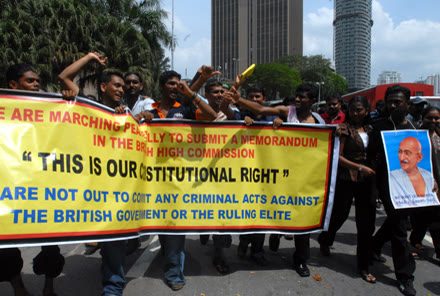
Reader Comments
Be the first to share your thoughts.