What Did the Pangkor Treaty Change?
In January 1874, a single word traded away a country—and that word was "advice"
One morning in January 1874, a British warship lay anchored off the coast of Perak.
The ship was called the Pluto.
On the deck, several men sat facing each other, ready to sign a document. One of them was Raja Abdullah, a claimant to the Perak throne, who had previously asked a merchant to write to the British on his behalf, asking them to help him win back that seat. Sitting opposite him was the British Governor of the Straits Settlements, Andrew Clarke.
Together, they signed that document.5,6
That document is what we call today the Pangkor Treaty (Perjanjian Pangkor).
To explain what happened before this day, we must first start with the mines.
Two Factions, One Waterway#
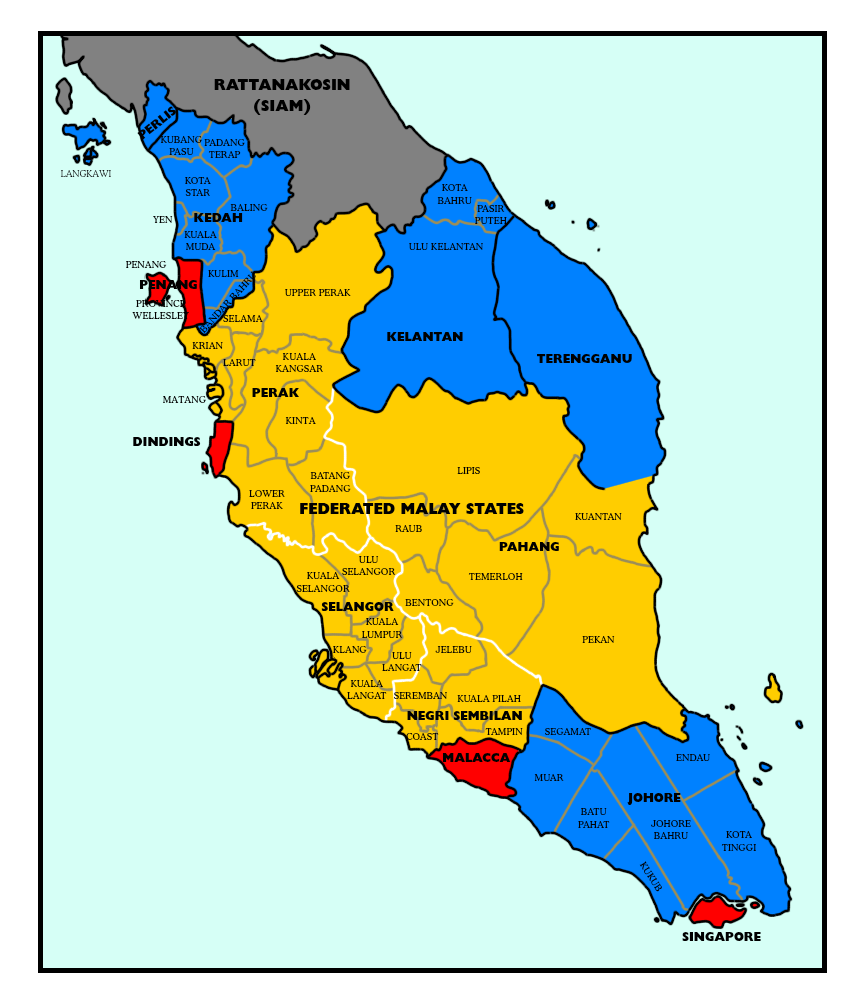
There is a place in northern Perak called Larut.
In the mid-nineteenth century, vast amounts of tin ore lay buried beneath the ground here. Mining tin was grueling work, and there were not enough locals to do it. The mine owners brought in tens of thousands of workers from southern China.
These workers were not a unified group. They belonged to two different secret societies—
Hai San: Composed primarily of Hakka miners.2,3
Ghee Hin: Composed primarily of Cantonese, Teochew, and other non-Hakka dialect group miners.2,3
The two factions shared a single waterway to channel water to their mines. In 1861, a dispute over the control of this waterway sparked the first war.2,3
This was followed by 1865, then 1872, and 1873—four wars in total, each with a recorded name and a traceable flashpoint.2,7
We need to pause here to clarify something.
The Larut Wars were never merely "infighting among the Chinese". They were a chaotic scramble involving mining interests, secret society power, and the Perak royal family. Backing the Hai San was Ngah Ibrahim, the Mantri of Larut, while the Ghee Hin, by the fourth war, had switched their support to Raja Abdullah.2,7 Every ignition point involved a specific mining area, a specific water channel, and specific commercial interests.
Secret societies, mining areas, and royal succession disputes—these three threads tangled into a knot in Perak. The British, watching this knot from the Straits Settlements, grew increasingly frustrated.
A Letter from Abdullah#
In 1871, Sultan Ali of Perak passed away.
According to custom, the successor should have been Raja Muda Abdullah. But Abdullah was not present that day—he later claimed he feared being ambushed on the way, so he didn't attend.2,4
The state chiefs waited for forty days. Under the strong pushing of the Mantri of Larut, Ngah Ibrahim, they installed another man as the new Sultan: Bendahara Ismail.4,6
Abdullah viewed this as a usurpation. He refused to recognise it.
The British watched from the sidelines for two years, growing increasingly uneasy about the increasingly chaotic hinterland. By 1873, the situation was threatening the tin trade of the Straits Settlements. When the new Governor, Andrew Clarke, arrived, the instructions from Whitehall left him some leeway—if invited, he could intervene.
So, Abdullah wrote a letter to Clarke, passed through the Chinese merchant Tan Kim Cheng and the British merchant William Henry Macleod Read, the gist of which was: I am willing to accept a British Resident; please recognise me as the legitimate Sultan.6,8
Clarke agreed.
The two sides arranged to meet in the waters off Pangkor Island.
That Document on the Warship Deck#
On 20 January 1874, the treaty was signed.5,6
One of the British officials present was Frank Swettenham. Thirty-three years later, he wrote about this day in his book—British Malaya, published in 1907. He recorded: In the days leading up to the meeting, the group gradually gathered at Pangkor; Raja Abdullah arrived, his relative Raja Idris arrived, the Raja Bendahara, the Mantri, the Temenggong, the Dato Sagor all arrived, as did the secret society leaders.
But Raja Ismail and Raja Yusuf did not arrive. Swettenham wrote that they were "too far away" and "made no effort to attend".5,6
This point is worth pausing on: the document that decided the fate of Perak was signed at a table missing the Sultan who was actually on the throne at the time.
The treaty had eleven clauses, a few of which must be clarified here.
Clause Six, which Swettenham transcribed verbatim in his book, reads:
"That the Sultan receive and provide a suitable residence for a British Officer, to be called Resident, who shall be accredited to his Court, and whose advice must be asked and acted upon in all questions other than those touching Malay religion and custom."5,6
The Sultan must receive a British Resident. His advice must be asked and acted upon in all matters—except for religion and custom.
Clause Ten, in its English version:
"That the collection and control of all revenues and the general administration of the Country be regulated under the advice of these Residents."5,6
The collection of taxes and the general administration of the country must be regulated under the "advice" of the Resident.
Swettenham's own commentary on these two clauses was: "The two most important clauses are as follows".5,6 He was not wrong.
The treaty also confirmed: Britain recognised Abdullah as the legitimate Sultan; the former Sultan, Ismail, was demoted to "Sultan Muda" (Deputy Sultan). On the same day, twenty-six Chinese secret society leaders, represented by Chung Keng Quee, boarded the warship and signed the treaty, ending the Larut Wars.6,8
There is one spot here where two versions must be shown to you side by side.
"Muafakat" vs "Must be acted upon"#
The treaty had a Malay version and an English version.
This does not rely on speculation. Swettenham himself wrote: "after some days of discussion, an instrument was drawn up in English and Malay, and was signed and sealed on January 20, 1874."5,6
In other words: a British official who was present confirmed that two language texts existed that day. And what we will look at next is how these two texts described the same thing differently.
In the English version of Clause Six, the key words are: must be asked and acted upon. This is the tone of a one-way command. What the Resident says, the Sultan does.
In the Malay version, according to an early Jawi manuscript cited by the Sembang Kuala blog, the keyword used was: muafakat. (The only public record of the word "muafakat" in the Malay version comes from this blog; we could not verify the original manuscript in this round of research.)1,5
Muafakat in Malay means "bilateral consultation" or "consensus"—both sides discuss and agree; it is not one side issuing orders and the other executing them.
This discrepancy was not a translator's slip of the pen. Nor is it a minor academic detail.
It is a fundamental fact: the document the Sultans signed, and the one later executed in London, contained two different textual descriptions of "how the Resident should operate".1,5
Scholar Raja Dato Seri Azam once raised this point, arguing that the semantic gap between the two versions is key to defining the nature of the entire Residency system. (This scholar's stance is recorded by the Sembang Kuala blog; this site has not read the scholar's original text.)1,9
This site cannot adjudicate this dispute—we do not have the original Malay document from that day, only later copies and the English records of British officials. But this discrepancy is real, and it is important, because what happened next grew precisely out of this gap.
What is Called "Advice"#
Abdullah probably thought he had acquired an advisor.
J.W.W. Birch probably thought so too—but what was in his head was a different logic entirely.
James Wheeler Woodford Birch arrived in Perak on 4 November 1874 to become the first British Resident.10,11
What did he bring? A tax system. Notices posted in villages announcing that the British were coming to collect taxes. The problem was, these notices went up directly, bypassing the Sultan and the local chiefs.10,11
He did not speak Malay. He believed the chiefs lived by exploiting the people and should be abolished. His superior, Governor Andrew Clarke, privately warned him that he was moving too fast, but he persisted.10,12
According to a summary by the Economic History of Malaysia, Frank Swettenham once used a rather blunt comment to describe Birch's problem: he was "restless, interfering with murderers and criminals." **This site did not find this sentence in the full text of Swettenham's 1907 British Malaya**; it might be from his other works or unpublished archives. Thus, we can only write "according to that website's summary," and cannot attribute it directly to Swettenham as a direct quote here.13,14
Whether or not he wrote that comment, one thing is clear: Swettenham himself was a core architect of this system. Any comment from him carries the motive of exonerating the system itself.
The chiefs around Sultan Abdullah watched as a foreigner stripped their power piece by piece, and the exception clause "except religion and custom" in the treaty was woefully inadequate—because everything outside of "religion and custom" was, in fact, the entirety of power.
On 21 July 1875, Sultan Abdullah chaired a meeting of chiefs at Durian Sebatang.10,11
The meeting discussed how to deal with Birch. Two options were on the table: poisoning or assassination. Maharaja Lela volunteered for the latter on the spot. The attendees approved the plan.10,12
According to the indictment (as summarised by the Wikipedia entry for 'James W. W. Birch'), Abdullah chaired and attended this meeting. This site only reports what the indictment claimed, not passing a final judgement on the matter.10,12
2 November 1875#
On that day, Birch was travelling by boat on the Perak River and docked at Pasir Salak. He was in the boat's bathhouse, intending to freshen up.5,11
Maharaja Lela's men launched their attack. Birch was assassinated.5,11
Regarding the exact method, the two sources differ—Wikipedia notes he was "speared to death", while another record states he was "struck on the head with a sword". This site does not know the exact details, so we merely state he was assassinated.
The news reached the Straits Settlements, and from there, London.
On 6 November 1875, reinforcements set sail from Hong Kong and Burma. Britain dispatched a large expeditionary force, with the main body drawn from British India and Hong Kong.15,12
The aftermath of this event led every major figure in Perak to a different end.
Maharaja Lela and two followers were hanged at Matang (Taiping) on 20 January 1877.15,12
Sultan Abdullah II was exiled to the Seychelles.15,12
Ngah Ibrahim, the Mantri of Larut, was also exiled, eventually ending up in Sarawak and dying in Singapore in 1895.15,12
The second Resident, taking over Birch's post, was Hugh Low. He spoke Malay, spent years understanding the local context, and was more tactful in his approach. Under his tenure, the situation in Perak gradually stabilised. The Residency system did not shrink because of Birch's assassination—instead, because of this crisis, and following the military suppression, the British implemented the system even more thoroughly.15,13
What That Exception Clause Grew Into#
Clause Six of the treaty had a tail end: "except those touching Malay religion and custom".
The original intent of this phrase was that the Sultan retained autonomy over Islamic affairs—the Resident could not interfere.
This phrase later became the core of a long-term mechanism: the Sultan's nominal authority over religion and custom was preserved, even institutionally reinforced—giving the Sultans the façade of "still being the sovereign".
Meanwhile, the Resident took everything else.
After 1875, the Residency system did not pull back because of Birch's death. The Perak experience was seen as a lesson—the problem wasn't the system, the problem was Birch pushing too hard. A Resident with a better sense of boundaries and more patience could maintain the same power structure, just less visibly.
Twenty-three years later, Swettenham himself wrote down the grammar of this system.
By then, he was the Resident-General of the Federated Malay States. Starting in 1897, the Sultans and chiefs of the four states met every few years at what was later called the "Durbar" (Rulers' Conference). Swettenham described it in his book like this:
"Nothing can be decided at the Council, which is only one of advice, for no Raja has any voice in the affairs of any State but his own."5,13
"Nothing can be decided at the Council, which is only one of advice, for no Raja has any voice in the affairs of any State but his own."
Please read this sentence alongside that document from 1874.
The Pangkor Treaty said: The Resident's advice must be asked and acted upon by the Sultan. Twenty-three years later, regarding the meeting where the Sultans gathered, Swettenham said it was "only one of advice", so nothing could be decided.
One word, two directions. The "advice" given by the British to the Malay rulers had to be obeyed; the "advice" given by the Malay rulers gathered together could decide nothing.
The man who wrote this sentence was the primary architect and driver of this system. He wasn't criticising it—he was explaining how it worked.5,14
The Grammar of "Advice"#
A single phrase was used to trade away a country—technically speaking, this method was quite ingenious.
It didn't say "cede". To "cede" would let the Sultan's subjects know it was a humiliation, potentially triggering a larger backlash.
It didn't say "colony". A "colony" requires a clear transfer of sovereignty, which wouldn't hold up legally because the Malay Sultan was still sitting there.
It said "advice".
The grammar of "advice" was the most technically sophisticated invention of this entire arrangement: sovereignty remained in name, while power departed in substance.
This grammar, after being used in Perak in 1874, was soon replicated elsewhere.
In 1874, a Resident was installed in Selangor. In 1875, Negeri Sembilan followed. In 1888, Pahang.13,14
Every state had its own negotiation, its own narrative of "the Sultan actively inviting"—the British consistently emphasised this because it made the system legally defensible: it was not conquest, it was an invitation.13,14
In 1896, Perak, Selangor, Pahang, and Negeri Sembilan merged into the Federated Malay States. In this new structure, the Sultans' power of "advice" was diluted even further.
The Sultans signed the Pangkor Treaty, thinking they had hired an advisor. They never expected that this advisor would bring the grammar of "advice" and, step by step, occupy every chair at the decision-making table.
The Next Question#
The Pangkor Treaty replicated a set of grammar in Perak. This grammar subsequently landed in Selangor, Negeri Sembilan, Pahang, and Johor.
By the early twentieth century, the census of the Federated Malay States began operating on a massive scale. The ledger used to manage populations employed another word: race (bangsa).
Who, when, and by what method divided the people of the Malay Peninsula into the "three major races"? This question emerged later than the Pangkor Treaty, but the answer it seeks stretches all the way to today.
The Evidence for This Article, Explained Clearly by This Site#
After writing, let's lay bare what supports this article:
**The hardest piece of evidence is Swettenham's 1907 British Malaya.** The verbatim texts of Clauses Six and Ten of the Pangkor Treaty, the signing process, who was present and who wasn't, the phrase "an instrument was drawn up in English and Malay", Maharaja Lela's prior threat, and the on-the-spot account when the news of the assassination arrived—all come from this book. This site directly read the full-text images on the Internet Archive to verify this, rather than relying on secondary citations.
But it is not a neutral record. Swettenham himself was a participating official: he was sent by the Governor to deliver messages in Larut in January 1874; he was in the same flotilla when Birch was assassinated in November 1875; and he later rose to become the Resident-General of the Federated Malay States—which is to say, the highest executor of this system is the very person who recorded its birth for us. He wrote that Ismail was a "scoundrel", a term this site did not adopt. When reading this article, please keep both "he was there" and "who he was" in mind.
The rest relies mostly on secondary sources. The critical discrepancy over the Malay word "muafakat" is publicly recorded only via a Jawi manuscript cited by a blog, and this site could not verify the original document—yet this is one of the fulcrums of this article's argument, which is why its weight is explicitly stated in the main text. The Larut Wars, the details of Birch's administration, the subsequent military actions and executions, are largely sourced from Wikipedia, Britannica, and several specialised websites.
There are also three books that this site has not read. Cheah Boon Kheng (JMBRAS 1998), Emily Sadka (1968), and Khoo Kay Kim (1972)—these three are the standard academic works for this period of history. This site only verified their bibliographies and did not read the main texts, so they count only as notes here, not evidence. What is missing to make this article as strong as the earlier chapters are these three books.
The content related to Birch's assassination strictly follows the phrasing "according to the indictment", and makes no judgements on Abdullah's degree of responsibility beyond what is recorded in court documents.
Next article: The treaty traded away power. Next, a form would change a word. That word was 'race'.
Sources 15 Every important claim here can be checked. Open it and see.
Do not trust this site. Check it — every source below is clickable.
-
View excerpt ↓
The First Larut War began in July 1861 when arguments over control of watercourse to their mines escalated and led members of the Hai San Secret Society to drive the members of the Ghee Hin society out of Klian Baharu.
-
View excerpt ↓
That the Sultan receive and provide a suitable residence for a British Officer, to be called Resident, who shall be accredited to his Court, and whose advice must be asked and acted upon in all questions other than those touching Malay religion and custom.
-
View excerpt ↓
The Pangkor Treaty of 1874 was a treaty signed between Great Britain and the Sultan of Perak on 20 January 1874, on the Colonial Steamer Pluto, off the coast of Perak.
-
Search for this source ⌕ no direct link — this button searches for the work 2026-07-30 Report this source
-
Search for this source ⌕ no direct link — this button searches for the work 2026-07-30 Report this source
-
Secondary Wikipedia, 'James W. W. Birch', https://en.wikipedia.org/wiki/James_W._W._Birch —— Birch 遇刺经过、施政风格
View excerpt ↓
Birch was killed on 2 November 1875 by followers of a local Malay chief, Maharaja Lela, including Sepuntum, who speared him to death while he was in the bath-house of his boat.
-
Search for this source ⌕ no direct link — this button searches for the work 2026-07-30 Report this source
-
View excerpt ↓
Written by Frank Swettenham, the first Resident-General of the Federated Malay States (FMS), the book details the history of British presence in Malaya beginning with the Straits Settlements ports of Singapore, Melaka and Penang.
-
View excerpt ↓
The former was captured and hanged in Matang with two followers in 1877, while the latter two were exiled to the Seychelles.
This site is written with AI assistance. Please check us.
AI can invent citations that look completely convincing — a real author's name, a plausible title, a sensible year, for a work that does not exist. This is not a theoretical risk; it is a known failure mode. That is why every source on this site is clickable. If a reference cannot be found anywhere, it may well not exist — and we want to know.
How to check us →
Reader Comments
Be the first to share your thoughts.