How Did Britain Enter Malaya?
Thirty-eight years, three negotiations, three islands—the British didn't fight their way in; they talked their way in
In 1786, an Englishman named Francis Light docked at an island. The island belonged to the Sultan of Kedah, off the northwest coast of the Malay Peninsula. Today, it is called Penang.
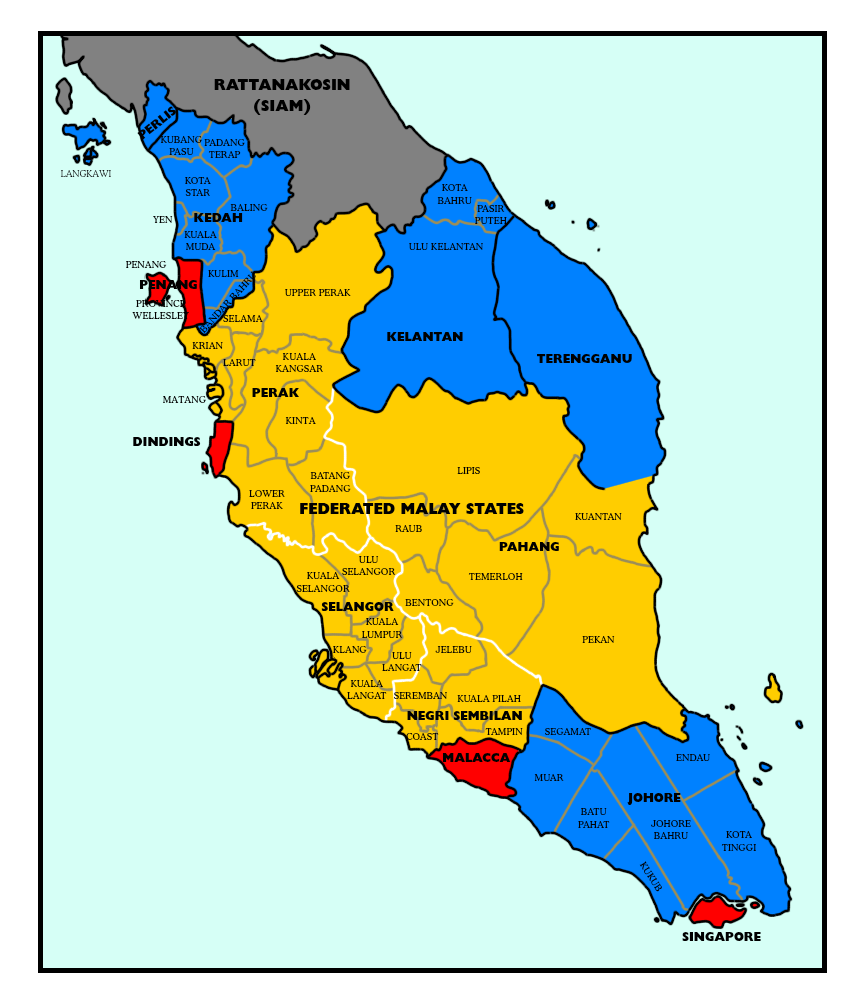
He didn't arrive with an army to conquer it. He came alone to negotiate first, and only when the talks succeeded did he plant his flag.
From that year to 1824, thirty-eight years passed. In those thirty-eight years, the British entered three islands: Penang, Malacca, and Singapore. Every time, they didn't use cannons; they used a promise at the negotiating table. Every time, that promise was about the same thing: a Malay ruler needed someone to protect him, and the British said, "We will."
And then it turned out that the situation was not as he thought.
Part One: What the Sultan Needed That Year#
In 1786, the situation facing the Sultan of Kedah, Abdullah Mukarram Shah (the 19th Sultan of Kedah), was this: pressure from Burma to the east, and threats from Siam to the north.
What he needed was not a dock; what he needed was an ally who could hold off Siam.
Francis Light started as a private trader, running oceangoing trade on behalf of the East India Company (EIC). He had done business around the Malay Peninsula and Siam for years and spoke Malay. He knew what the Sultan wanted, and he also knew what his boss—the EIC—wanted: a stopover in these waters to repair and resupply ships without having to look at the faces of the Dutch and the French.
The two sides hashed it out. According to records on britishmalaya.home.blog and cilisos.my, the main terms of the agreement were: Kedah would lease Penang Island to the British for an annual rent of thirty thousand Spanish dollars. The British would deploy armed vessels in the strait and lend Kedah six thousand Spanish dollars to pay off debts to Siam. (This agreement was oral or an informal arrangement; no original formal treaty document is found in public records.)
There was one more clause—the one the Sultan of Kedah cared about most.
Light told him: the King of England and the Governor General would "assist him in whatever he requires". (Quote from britishmalaya.home.blog and cilisos.my; no primary written source for Light's words is found in public records.)
What the Sultan of Kedah heard was military protection.
The itinerary recorded by Swettenham is as follows: on the afternoon of 14 July 1786, Light sailed from Kedah and dropped anchor at Penang the next morning. The following days were spent unloading troops, cargo, and cannons, clearing land, making camp, building huts, outlining a fort, and erecting a flagpole. On 11 August, the flag was raised.4,1
Swettenham recorded the full text of the declaration of occupation word for word in his book. When you read it, you will notice what it does not say—it only invokes "the orders of the Governor-General and Council of Bengal" and the name of "His Britannic Majesty George III and the English East India Company". It mentions neither the Sultan of Kedah, nor any terms of exchange, nor any promise of protection.4,1
The Problem with That Promise#
There is a truth here that was only spoken later.
When Light made that promise of protection, his boss had never authorised him to do so.
In 1788, according to a report by cilisos.my, Light admitted it himself: the military assistance he promised the Sultan at the time "was something the EIC was incapable of fulfilling." The EIC had authorised him to initiate negotiations, but did not authorise him to promise military aid. (The only searchable sources for this claim are cilisos.my and britishmalaya.home.blog; the original text of Light's 1788 letter has not been verified in public records.)
There is a letter that serves as circumstantial evidence. On 18 June 1787, Light wrote to Governor Cornwallis, explaining to his superior the reasons for landing on the island. Swettenham quotes this letter verbatim in his book. The reasons in the letter were entirely about shipping needs: there was no safe place to repair and anchor ships east of the Bay of Bengal, and all British captains were complaining about it. There was not a single word about a promise of military protection.4,1
The reason is not hard to guess: the EIC did not want to offend Siam for the sake of defending Kedah. They wanted a trading post, not a diplomatic battlefield.
The Sultan of Kedah waited for a few years, the pressure from Siam grew greater, and British reinforcements never came. (According to cilisos.my and stampaday.wordpress.com, this is a fact unanimously agreed upon by all sources.)
In 1790, the Sultan had had enough and began assembling a fleet at Prai (across the strait from Kedah) to take back Penang by force.
Light beat him to it. In April 1791, before the Kedah forces finished assembling, he launched a night raid and routed the Sultan's fleet.
After the defeat, the Sultan was forced to sign a new agreement. The annual rent was slashed from thirty thousand Spanish dollars to six thousand Spanish dollars. The British secured permanent possession. (The only record of the above three paragraphs of facts comes from academic interviews reported by stampaday.wordpress.com and thevibes.com; no dual primary archival sources are found in public records.)
From thirty thousand to six thousand, this was the final price of "delivering in a way that differed from what he understood".
Cannons Firing Gold Coins#
There is a story circulating in Penang about those early days after Light landed on the island.
Legend has it that to encourage his men and the locals to clear the jungle, he loaded a cannon—not with a cannonball, but with bags of silver Spanish dollars. When the cannon fired, the coins shot into the bushes, and people rushed to pick them up, chopping down the trees in the process.
This story is very common in Penang's tour guidebooks and souvenir shops, sometimes called "Light's clever trick."
It is very likely made up.
Research by britishmalaya.home.blog notes that "contemporary written evidence for this event is extremely thin", while records from the Straits Oriental Museum in Penang label it directly as "probably apocryphal". There are no contemporary primary documents recording that this event ever happened.
But that is not the most interesting thing about this story.
What is interesting is why people keep telling it. A clever outsider used money to buy the labour of the locals, and everyone was happy—this version frames colonial entry as a consensual transaction, pleasing everyone, with no victims.
Storytellers need this version. So it has been passed down.
Light's Methods: Two Readings#
As to what kind of person Francis Light really was, historians have yet to reach a consensus.
Scholar Marcus Langdon takes a moderate stance: Light was an "agent who overstepped his authority", and his promise of protection was a personal overreach, not a systemic deception. There was always a time lag between EIC policy and what he did on the frontlines.
Malaysian scholars Ahmad Murad Merican and Ranjit Singh Malhi take a much stronger stance: according to a report by The Vibes, these two scholars argue that Light "unilaterally and hastily landed on the island while the Sultan's conditions were unmet", which legally and morally constituted a deception of the Sultan, making it a de facto illegal occupation.
Whether there was ever a formal treaty signed between the Sultan of Kedah and Light remains a dispute today. According to Ibrahim Bakar, chairman of the Kedah Historical Society, "there was no formal treaty signed in 1786 at all"; whereas scholar Langdon believes there was a treaty, but it was signed only after Kedah's defeat in 1791. (The only searchable sources for these two academic stances are thevibes.com and britishmalaya.home.blog; no primary document verification of this dispute is found in public records.)
This site will not adjudicate which of these two stances is right. Only one thing can be adjudicated: what the Sultan of Kedah finally got was not what he thought he had negotiated.
Part Two: The Coming and Going of Malacca#
The story of Penang wasn't over when, in 1795, another city changed masters.
Malacca at that time was Dutch territory—the Dutch East India Company (VOC) had managed it for one hundred and fifty years after driving out the Portuguese in 1641.
But in early 1795, the map of Europe changed. French troops marched into the Dutch Republic, established the "Batavian Republic", and declared war on Britain. According to records by morethannelson.com (British naval history research) and colonialvoyage.com, the exiled Dutch stadtholder William V issued a series of directives in January of that year—historically known as the "Kew Letters"—ordering the governors of all Dutch colonies to temporarily hand over jurisdiction to the British to prevent these places from being captured by the French.
On 17 August 1795, British naval Rear-Admiral Peter Rainier arrived at the Strait of Malacca with his fleet. The Dutch Governor of Malacca, Abraham Couperus, initially refused, but under the guns of British warships, surrendered that day. Major Archibald Brown led the troops ashore. (The source for the above facts is morethannelson.com and colonialvoyage.com; no dual independent primary archival sources for this segment are found in public records.)
And so the British entered Malacca—on the pretext of "temporarily managing" it for their Dutch allies.
That "temporary management" lasted twenty-three years.
There was an interlude: in 1814, Britain and the Netherlands signed a treaty in Europe, requiring Britain to return the Dutch territories occupied during the war. In 1818, the British Resident William Farquhar handed Malacca back to the Dutch representative Jan Samuel Timmerman Thijssen; the Dutch resumed control, keeping it until it changed hands again in 1825. (Source: colonialvoyage.com and Wikipedia's Straits Settlements entry; no primary archival verification found in public records.)
These twenty-three years of coming and going connect the ending of the previous article, 'The Return of the Royal Lineage to the South', and form the backdrop to Raffles' Singapore story: Malacca bounced back and forth between the British and the Dutch, but Dutch power around Riau remained—this was the foundation for the ensuing chess game.
Part Three: That Exile's Throne#
On 29 January 1819, a ship set out from Bencoolen (now Bengkulu Province in Sumatra), headed north, and entered the Johor Strait. The man on board was Stamford Raffles, then Lieutenant-Governor of the EIC in Bencoolen.
He came here because he knew the Dutch had just set a trap in Riau, and he didn't have much time.
In November 1818, according to a record by ISEAS researcher Benjamin Khoo in BiblioAsia (an academic publication of the National Library of Singapore), the Dutch had already signed a treaty with the Bugis viceroy (Yamtuan Muda) of Riau, Raja Ja'afar. Using the seal of the reigning Sultan, Abdul Rahman, the Dutch stationed about one hundred and fifty troops in Riau (with Königsdorffer appointed as the Dutch Resident). The Dutch's meaning was clear: the Johor-Riau Sultanate is on our side.
Raffles needed a breakthrough point.
He found a man: Hussein Mua'zzam Shah, originally named Tengku Long, born in 1776, whose father was the Sultan of Johor, Mahmud Shah III.5,6
This man had a story.
In 1811, his father passed away. At that time, he was in Pahang marrying a new bride; when the monsoon came, the ships couldn't sail, and he couldn't return.
The Riau court couldn't wait. In his absence, the Bugis viceroy Raja Ja'afar hastily installed his half-brother Tengku Abdul Rahman on the throne overnight.
More crucially, according to records from the National Heritage Board of Singapore (Roots.sg), Raja Ja'afar wrote to Hussein informing him: "Your father has passed away." The letter made no mention of the fact that his brother had already ascended the throne.5,6
By the time Hussein arrived, someone else was sitting on the throne. He went into exile on a small island in the Riau Archipelago called Penyengat, living there for eight years with nothing.
Raffles' men found him.
That Promise Was the Same Ticket#
On 30 January 1819, Raffles first signed a bilateral preliminary agreement with the local Temenggung Abdul Rahman, allowing the British to anchor and trade in the area.5,3
Then, he had Hussein secretly brought over from Penyengat Island.
On 6 February 1819, a formal tripartite treaty was signed: Raffles, Temenggung Abdul Rahman, and the newly recognised Sultan Hussein Shah.5,3
The treaty's contents: the EIC was permitted to maintain a factory (trading post) in the Sultan's hereditary domains; Hussein would receive five thousand Spanish dollars annually; the Temenggung would receive three thousand Spanish dollars annually; the British promised to protect the Sultan from external attacks but would not intervene in internal disputes; the Sultan promised not to sign treaties with any other foreign powers.5,7
For Hussein, the value of this deal was not the five thousand dollars, but British recognition. With the British flag behind him, he was now a Sultan.
For Raffles, the value of this deal was a piece of legal basis for signing a treaty.
We Must Pause Here#
This is the most morally heavy segment of this article, and it must be explained clearly.
The basis for Hussein becoming Sultan—from the perspective of the Malay aristocratic system, was disputed.
He was the eldest son and theoretically had the right of succession. But a successor's ascension requires traditional ceremonies and recognition from the nobility; these things he had never received. The nobles of the Riau court, the Bugis viceroy, and the Dutch who had already recognised Abdul Rahman as Sultan—none of these three parties recognised him. (Original text from Wikipedia's Hussein Shah of Johor entry: "by all accounts not recognised by the Malay rulers".)5,8
Raffles knew this. His legal argument was not "Hussein was already the legitimate Sultan", but "I am recognising him now, therefore he is."
The Dutch protest was as follows: they had already signed a treaty with Riau in 1818, and the Riau Sultan Abdul Rahman was the legitimate party; Hussein was an exile without formal traditional authorisation, so Raffles' treaty with him was legally invalid. According to the records of BiblioAsia researcher Benjamin Khoo and the New World Encyclopedia, the Dutch lodged a formal diplomatic protest.2,9
Raffles' countermeasure also followed legal logic: the Temenggung was the local authority in Singapore, so the preliminary agreement did not infringe on sovereignty; then, by recognising Hussein, he upgraded the counterparty—now the problem became "which Sultan is legitimate", not "whether the British have the right to be here".
Initially, under diplomatic pressure, the British homeland publicly disavowed Raffles' actions. Ultimately, they chose to support the fait accompli.
The Dutch eventually did not fire their guns, resolving it at the diplomatic table—Article 12 of the 1824 Anglo-Dutch Treaty explicitly stated: "His Netherland Majesty withdraws the objections which have been made to the occupation of the island of Singapore".2,10
That diplomatic table was in London.
And so the Johor-Riau royal lineage was effectively split in two: the southern Sultan in the Dutch sphere (Riau, Abdul Rahman), and the northern Sultan in the British sphere (Singapore, Hussein).
Two sons of the same father, managing fragments of the same royal lineage in two different directions—one got the Dutch flag, the other got the British flag.
No one asked them that their father's royal lineage was originally a whole.
Part Four: That Table in London#
The Dutch protests, the British fait accompli, plus both sides having even larger interests to settle in Europe and Asia—all these accumulated up to 1824, requiring a settling of accounts.
On 17 March 1824, Britain and the Netherlands signed a treaty in London. The signatories: George Canning and Charles Williams-Wynn for the British; Hendrik Fagel and Anton Reinhard Falck for the Dutch.2,11
Of these four men, not a single one was from the Malay world.
What the treaty exchanged: Britain ceded Bencoolen (all British possessions in Sumatra) to the Netherlands; the Netherlands ceded Malacca (Dutch interests on the Malay Peninsula) to Britain, whilst formally withdrawing all protests against Singapore.2,11
Why was Britain willing to trade? According to the analysis of sea-treaties.org, from London's perspective, the calculation was simple: Sumatra was too far, hard to govern, and yielded limited returns; whereas the Malay Peninsula and Singapore were the chokepoints to the China trade. Exchanging Bencoolen for Malacca, plus the legalisation of Singapore, was a bargain. The treaty itself is proof: Article IX transferred all of British Sumatra to the Netherlands, and Article X transferred Malacca to Britain.2,11
From that day on, the Strait of Malacca had two sides: the north was the British sphere of influence, and the south was the Dutch sphere of influence.
'The Return of the Royal Lineage to the South' has already quoted Articles Nine and Ten of the treaty verbatim and made clear that the text of the treaty does not mention the word Riau—the division of Riau was an implicit consequence of the "south of the straits belongs to the Dutch sphere of influence" arrangement, not an explicit clause. This article will not repeat it.
On 1 August 1826, the Straits Settlements were formally established, merging the three British outposts into a single administrative unit: Penang (including Province Wellesley), Singapore, and Malacca. (The administrative consequence after the territorial arrangements of the 1824 treaty were completed; the establishment date is per NLB Singapore and Wikipedia's Straits Settlements entry, which are consistent in public records.)2,12
The initial governing body was the English East India Company (EIC), with the administrative capital in George Town before moving to Singapore in 1832.
There is a common misconception here: the Straits Settlements only officially became a Crown Colony on 1 April 1867, when jurisdiction was transferred to the British Colonial Office. (The 1867 Crown Colony date is per NLB Singapore and Wikipedia's Straits Settlements entry; the 1824 treaty established British territorial control, while the Crown Colony status was a subsequent administrative arrangement.)2,13 When established in 1826, it was an EIC jurisdiction, not a colony directly managed by the British government.
Thirty-eight years, three negotiations, three islands. The entry ticket was the same every time: find a ruler who needs foreign assistance, give him a promise, and walk through the door.
This tactic would be used one more time later on.
Only the next time it was used, it was no longer about a Sultan's desire for foreign assistance—it used internal strife between Sultans, and a position called "Resident", nominally an "advisor" but in reality the one calling the shots.
Sources 13 Every important claim here can be checked. Open it and see.
Do not trust this site. Check it — every source below is clickable.
This site is written with AI assistance. Please check us.
AI can invent citations that look completely convincing — a real author's name, a plausible title, a sensible year, for a work that does not exist. This is not a theoretical risk; it is a known failure mode. That is why every source on this site is clickable. If a reference cannot be found anywhere, it may well not exist — and we want to know.
How to check us →
Reader Comments
Be the first to share your thoughts.