What Did Keling Originally Mean?
Malacca had a large number of South Asian merchants — but their "country" at the time was not called India
This is the story of a word that traveled two thousand kilometers.
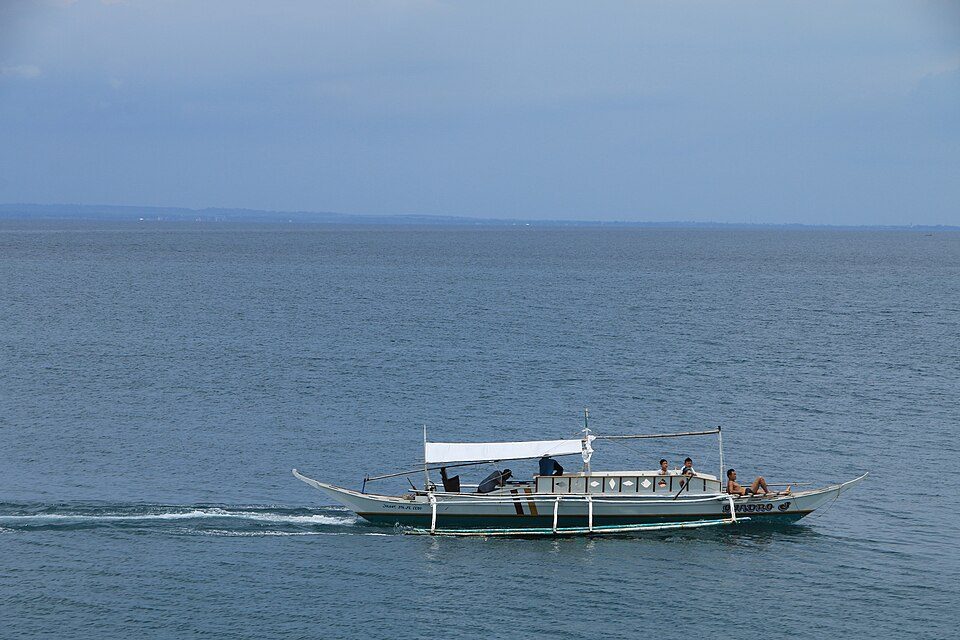
A full four hundred years before the founding of Malacca, the armies of the Chola dynasty had already reached these waters. In Tanjavur (in today's Tamil Nadu), there is a temple where the walls are carved with an inscription recording the martial feats of King Rajendra Chola I: around the year 1025, he led an army across the sea, attacking Srivijaya and thirteen other places, including a place called Kadāram. 5,6
The mainstream academic opinion is that Kadāram is today's Kedah. 5,6
That expedition was one of plunder, not conquest. 7,6 The Chola army left no administrative institutions here, and around 1028 Srivijaya had already resumed its tribute missions. Four hundred years later, when Malacca rose along the shores of this strait, people from the Chola homelands were already regular visitors here.
That Word#
When discussing the position of South Asian merchants in Malacca, one cannot avoid the word: Keling.
Today, this word carries a derogatory connotation in Malaysia and should not be used as a slur against people. This must be stated clearly upfront. However, it is an original term in historical sources, and its usage in 15th-century literature was completely different from today — it was not an insult, but a geographical identifier, much like saying "a Cantonese person."
How did the semantics change? The timeline itself is the answer. 8,3
"Keling" comes from Kalinga — an ancient kingdom in eastern India, located around modern-day Odisha, encompassing the Puri and Ganjam regions. The evolution of its orthography follows a pattern: from Kalingga, the final consonant cluster was dropped, shrinking to Keling. 8,3
This name first appeared in Malay literature in the Sejarah Melayu (Malay Annals). 3,8 Independently, the Portuguese historian Castanheda (writing between 1528–38) called this same group of South Asian merchants in Malacca "Quelins." 4,8 Two sources, from two languages and two writing traditions — referring to the exact same group of people.
When did it become derogatory? The publication years provide evidence: 9,3 The 1960 edition of the Malay storybook Cherita Jenaka used "orang Keling," but by the 1963 edition, the very same sentence had been changed to "orang India." Not in 1460, not in 1560 — but in the 1960s. Twentieth-century politics turned a geographical term into a slur; this is not a historical fact, but the aftermath of history.
"India" Did Not Exist Yet#
This is the most important sentence in this article, and it needs to be said slowly.
Between 1400 and 1511, the South Asian subcontinent was never a unified country called "India." 2,1 There were many regimes on that land, and the most important ones to Malacca were:
- The Vijayanagara Empire (1336–1646) — Controlled the Coromandel Coast and the southern Deccan Plateau, with major ports at Pulicat and Nagapattinam. 10,1
- The Gujarat Sultanate (1407–1573) — Controlled the west coast, with its main port at Cambay. 10,1 (Note: Muzaffar Shah I declared independence around 1394 and officially took the title of Sultan and minted coins in 1407. Academia generally uses 1407 as the official founding year of the Sultanate.)
- The Bengal Sultanate (1342–1576)
- The Pegu Kingdom — A Mon regime in Burma, whose merchants were also active in Malacca at the time
Each of these regimes had its own king, its own laws, and its own flag. Lumping them all together as "Indians" is projecting today's nation-state map five hundred years into the past — which is exactly what we must avoid here. 2,1
A brief interjection on geography, as these names are likely unfamiliar to today's readers. Gujarat still exists today — it is a state in western India, and its name has not changed in five hundred years. Its main port back then, Cambay, is today's Khambhat; another ancient port, Broach, is today's Bharuch, a city situated at the mouth of the Narmada River, which the Greeks and Romans earlier called Barygaza. The ports along this coastline took turns handing over the baton: by the 17th century, Cambay, Surat, and Bombay had taken over the business from Bharuch.
For this geographical name mapping, this site checked the Wikipedia entry for Bharuch and the eponymous special feature by the Indian history publication Live History India. Both say the same thing — but both are secondary sources, without academic monographs to back them up. So no citation mark is placed here: it merely provides the reader with a position on a modern map and does not carry any argumentation for this article. The real evidence is in the Pires section below.
In other words, the most important of the four port masters managed ships coming from today's western coast of India. These people were not "Indians" — there was no such country at that time; they were merchants from the Gujarat Sultanate, sailing out of the port of Cambay.
The Malaccan court itself is the best witness.
The Four Syahbandar (Port Masters)#
How did Malacca maintain order? It relied on a system that separately managed merchants coming from different places: four Syahbandar (port masters), each responsible for merchant ships from one specific route.
Tomé Pires recorded this system. He was a Portuguese who visited Malacca after its fall in 1511 and wrote what he saw and heard in the Suma Oriental. The Malacca he saw with his own eyes was only a few years removed from the fall of the empire, so memories of that system were still alive.
He wrote that the second port master was responsible for the "men of Coromandel, men of Bengal, men of Pegu, and men of Pasai." 1,11
Look at that: Coromandel people, Bengal people, Pegu people — listed separately.
The Malaccan court did not use the word "Indians" as an umbrella term for them. It used place names, port names, and monsoon routes. Because in that era, that was the only classification that made sense — which direction you came from, which seasonal wind you rode, and which port master you reported to determined who you were. 1,12
Pires and That Sentence About Cambay#
Among these four groups of merchants, the group from Gujarat was the most powerful.
Pires wrote a sentence that is still frequently quoted centuries later: "Malacca cannot live without Cambay, nor Cambay without Malacca, if they are to be very rich and very prosperous." 1,2
He also wrote down a number — there were about one thousand Gujarati merchants in the city of Malacca, with four to five thousand sailors coming and going. 1,2 (Both of these statements come from Vol. I, p. 45 of Cortesão's 1944 English translation. This site has verified the page numbers directly from the Internet Archive's image scans. There is another record in Vol. II, p. 255 of the same book, describing the situation when the Portuguese Sequeira arrived in 1509 — stating that together with Parsees, Bengalis, and Arabs, there were "more than four thousand men." These two numbers are for different events; do not mistake them as contradictory.)
These people belonged to the Gujarat Sultanate, established in 1407 and only annexed by the Mughal Empire in 1573 — perfectly overlapping the hundred years of Malacca's golden age. 10,1 They were not "Indians," they were merchants of the Gujarat Sultanate, with their main port in Cambay.
Tamil Muslims in the Court#
A presence even deeper and more stable than the merchants were the Tamil Muslims who held key positions in the Malaccan court.
The overall fact that Tamil Muslims held high positions in the Malaccan court is supported by academia. 2,1 Who exactly were they? There is an example here worth recording, but with an honest limitation:
According to records by scholar Sinnappah Arasaratnam (1979), as cited in a 2024 history column in Malaysiakini, the fourth and seventh Bendahara (prime ministers) reportedly had Tamil Muslim backgrounds. The Sejarah Melayu records that the father of one of these prime ministers was named Mani Purindam, meaning "great Indian merchant."
But it must be made clear: both of these are secondary sources. The page numbers of Arasaratnam's original book could not be directly verified this round, and the specific chapter in the Sejarah Melayu is yet to be confirmed. The fact that Tamil Muslims held key positions in the court is solid; pinning down the specific ethnic bloodline of a particular Bendahara requires more primary documents to assert. The text writes this out in layers of reliability, not making conclusions on behalf of the reader.
Which Route Did These People Take?#
Taking a ship from the Coromandel Coast, riding the northeast monsoon into the Strait of Malacca — this route was not new.
As early as around the 5th century, a sea captain named Buddhagupta had already taken this route. He was from Raktamrittika (modern-day Rajbadidanga in Bengal). During his journey, he erected a stele that was discovered in 1834 by British army officer James Low in Province Wellesley (today's mainland Penang). The stele is in Sanskrit, in Pallava script, recording his return voyage and thanking the Buddha for his protection. The original stone is now housed in the Indian Museum in Kolkata. 13,14
Buddhagupta's stele predates the founding of Malacca by nearly a thousand years. That route had been open all along.
A Surviving Community#
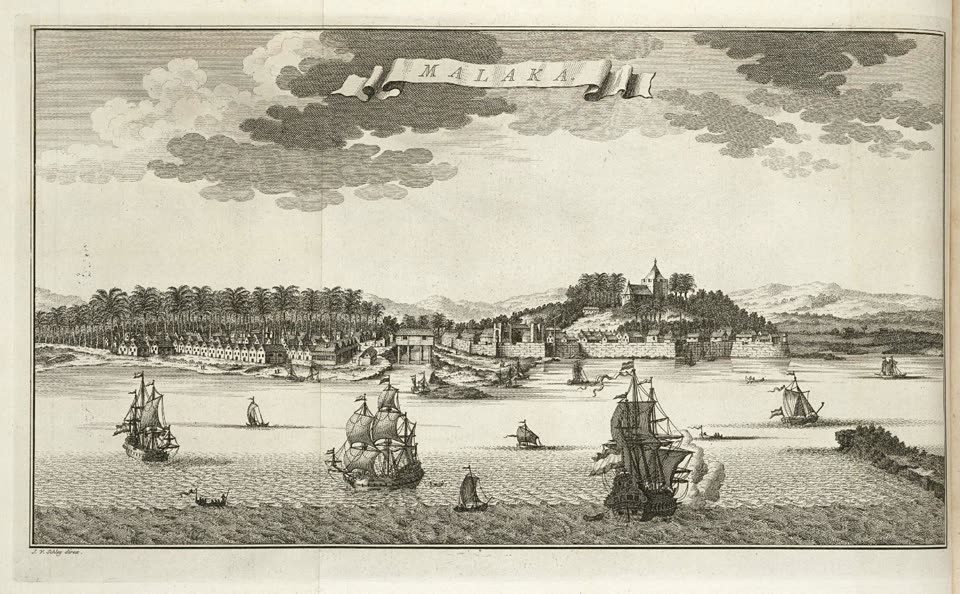
In 1511, the Portuguese battered their way into Malacca. The Sultanate collapsed, and the trade networks shattered.
But those descendants of Tamil merchants who had already settled here and intermarried with local Malay and Chinese women remained.
Today, there is still a community in Malacca called the Chetti Melaka (Indian Babas, also known as Chitty Melaka or Peranakan Indians). 15,16 Their ancestors were the Tamil merchants from that era, and their places of origin generally point to the Panai region in northern Tamil Nadu. 15,16
What language do they speak today? Not Tamil — but Malay. A Malay dialect heavily laden with Tamil vocabulary, which scholars call "Chetti Creole": they say nenek (grandmother, in Malay), but also thatha (grandfather, in Tamil), and mama (uncle, in Tamil). 15,16
What do they believe in? Hinduism, mostly of the Saivite (Shiva-worshipping) denomination. 15,16
A Malay-speaking Hindu community that has sustained itself on the old streets of Malacca for five hundred years. They are not a footnote in history — they are history itself, a living, breathing one.
Sources 16 Every important claim here can be checked. Open it and see.
Do not trust this site. Check it — every source below is clickable.
-
Search for this source ⌕ no direct link — this button searches for the work 2026-07-30 Report this source
-
Search for this source ⌕ no direct link — this button searches for the work 2026-07-30 Report this source
-
Search for this source ⌕ no direct link — this button searches for the work 2026-07-30 Report this source
-
Search for this source ⌕ no direct link — this button searches for the work 2026-07-30 Report this source
-
Search for this source ⌕ no direct link — this button searches for the work 2026-07-30 Report this source
-
Search for this source ⌕ no direct link — this button searches for the work 2026-07-30 Report this source
-
Search for this source ⌕ no direct link — this button searches for the work 2026-07-30 Report this source
-
Search for this source ⌕ no direct link — this button searches for the work 2026-07-30 Report this source
-
Search for this source ⌕ no direct link — this button searches for the work 2026-07-30 Report this source
This site is written with AI assistance. Please check us.
AI can invent citations that look completely convincing — a real author's name, a plausible title, a sensible year, for a work that does not exist. This is not a theoretical risk; it is a known failure mode. That is why every source on this site is clickable. If a reference cannot be found anywhere, it may well not exist — and we want to know.
How to check us →
Reader Comments
Be the first to share your thoughts.