The Princess Who Might Not Exist
The Sejarah Melayu tells a beautiful story. Whether the story itself is true or false is less important than another question: why was it written down?
In 1411, a procession walked into the city of Nanjing.
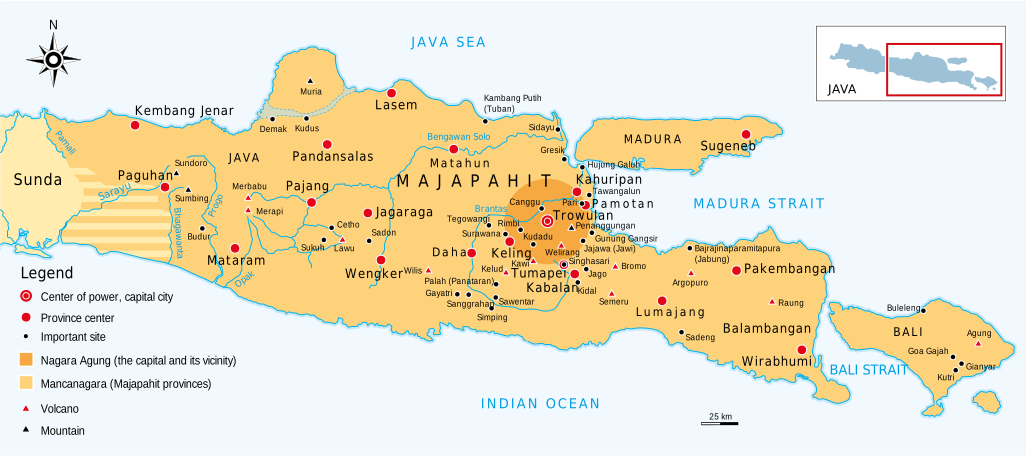
Walking at the front was the King of Malacca, bringing his queen and the crown prince, alongside over 540 followers.
He was not there for tourism. He was there for an imperial audience. From Malacca to Nanjing was a journey of thousands of miles, not an easy trip. But he made it.
This is not a legend. This event is recorded in the Ming Shilu (Veritable Records of the Ming Dynasty).
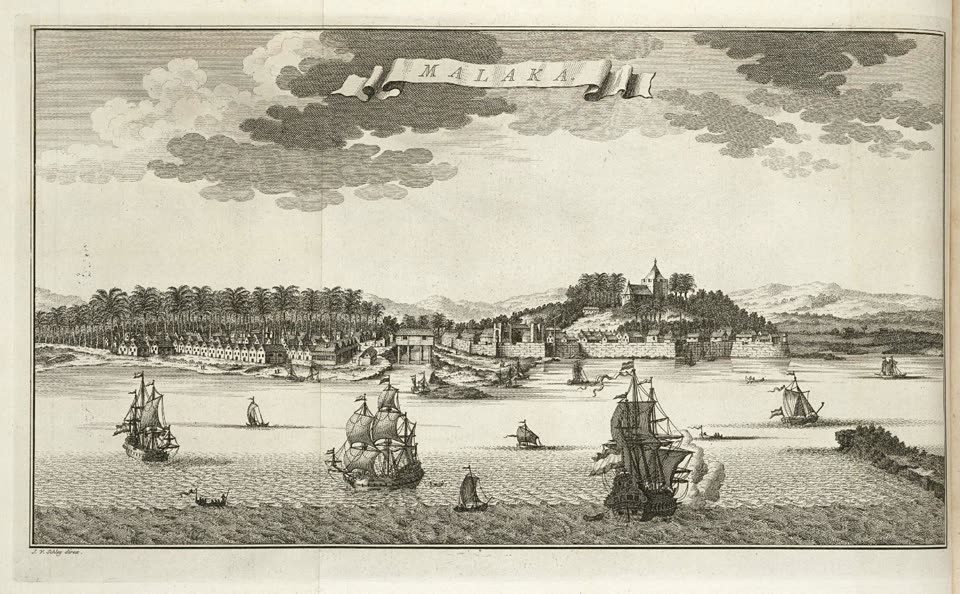
This audience is a microcosm of the relationship between Malacca and the Great Ming Empire in the early 15th century: exchanging envoys, bestowing titles and seals, and the frequent dockings of Zheng He's fleets. The guan chang — a large walled depot with watchtowers — was built right beside the port of Malacca. These are visible, documented facts.
But there is another story, one that has circulated longer than those archives and is far more captivating.
According to the Sejarah Melayu...#
It is said that the Emperor of China agreed to bestow a marriage, giving Princess Hong Li Po (Hang Li Po) in marriage to Sultan Mansur Shah of Malacca. The princess came ashore, bringing with her five hundred daughters of ministers as attendants. The Sultan granted them a hill east of the city to live on, called Bukit China. The Chinese dug a well at the foot of the hill, which people later called Perigi Hang Li Po.
This story comes from Chapter 15 of the Sejarah Melayu (Malay Annals).
The Sejarah Melayu was compiled around 1612 by Bendahara Tun Sri Lanang of the Johor court. 1,2 That was exactly one hundred years after Malacca fell to Portuguese cannon fire. Johor was the successor to the Malaccan royal line, and the purpose of writing this book was to "enshrine the sanctity and authority of a Malay ruler (daulat)" — this was the purpose written into the book by its own compilers.
So what kind of book is this? It is a court history, not a contemporary factual record. The compiler was separated by about 140 years from the era when Hang Li Po supposedly married Mansur Shah (around 1459–1477). 1,2
Is It in the Ming Archives?#
No.
In the extant Ming dynasty archives, there is no record whatsoever of dispatching a princess to Malacca. 5,3 The Ming Shilu (in Wade's 2005 digitized resource) contains numerous entries on interactions between Malacca and the Ming court, but no mention of a princess's marriage; the Wikipedia entry for "Hang Li Po" also explicitly states "there is no reference to Hang Li Po in any Ming dynasty records."
We must pause and think clearly about this fact itself: a princess marrying into a vassal state is a major diplomatic event, which customarily would leave traces in the archives of the Ministry of Rites or the Veritable Records. The Ming Shilu records many exchanges during Zheng He's voyages to the Western Oceans. But precisely this one is missing.
The name Hang Li Po cannot be found in any extant Ming dynasty archives. 5,3
Of course, some say that parts of Zheng He's archives were later destroyed, and certain events might be untraceable. This possibility is real. However, "possibly unrecorded does not mean it didn't happen" is not the same thing as "there is a record."
The person Hang Li Po: not corroborated in any public record.
That Well and That Hill#
If you go to Malacca today, you can still see the well called Perigi Hang Li Po, and you can still climb Bukit China.
There are over 12,000 graves on the hill. 6,7
But what year is the earliest of these graves?
Epigraphers Wolfgang Franke and Chen Tieh Fan conducted a systematic survey of the inscriptions on Bukit China, searching the entire hill, and found not a single tombstone that could be traced back to the 15th century. 7,8
The tombstone with the earliest readable date translates to roughly 1614 — but here is another layer of honesty to provide: the tombstone uses the sexagenary cycle (ganzhi) dating system without an accompanying dynastic reign name. Since the ganzhi cycle repeats every 60 years, those same two characters could mean 1614, or they could mean 1674. Franke and Chen Tieh Fan used the words "arbitrarily equated" in their research paper.
So what can this hill tell us?
It tells us that Malacca has a long history of Chinese settlement, and by the 17th century at the latest, it already had a sizable cemetery. It cannot tell us that Hang Li Po's 500 attendants were buried here in the 15th century.
This is not saying "the Chinese weren't here in the past." It is saying: using Bukit China to prove that 15th-century story is a dead end.
Let's Pause Here#
We have two things:
One, beautifully written court annals containing a story about a princess.
Two, the Ming royal archives, with not a single word about it.
Scholars have studied the space between these two things for a long time. Different people have reached different conclusions, and to this day there is no consensus.
This site will not make this conclusion for anyone.
But there is another matter, more interesting than "is she real or a legend."
Two Books, Two Sultans#
This is an unexpected harvest provided by research.
The Portuguese Tomé Pires wrote the Suma Oriental between 1512 and 1515. At that time, the Portuguese had just conquered Malacca, and there were still living eyewitnesses in Malacca, so Pires conducted extensive interviews.
Pires also recorded a story of a "Chinese woman marrying into the Malaccan Sultan's family."
But he said that event took place during the reign of the second Sultan, Megat Iskandar Shah — roughly 1414 to 1424.
The story in the Sejarah Melayu features the sixth Sultan, Mansur Shah — roughly 1459 to 1477.
The difference between the two is thirty-five to fifty years. They are not the same Sultan. 1,4
Place these two versions side by side here.
The exact same event of "marrying a Chinese princess," in two books, attributed to two different Sultans.
This fact itself requires no explanation. Leaving it there is enough.
What the readers see, the readers themselves know.
Official Interactions, Truly Verifiable#
Having said all this, one thing must be made clear: the official interactions between Malacca and the Great Ming Empire are real and documented.
In 1403, the Ming court dispatched an envoy to Malacca. In 1409, Zheng He bestowed a set of twin silver seals and erected a boundary stele for the country of Malacca. In 1411, the King of Malacca personally led 540 people to Nanjing for an imperial audience — this number comes from the Ming Shilu (Wade 2005 edition); this site has not found a second, independent source to corroborate this number.
Zheng He's fleets docked in Malacca multiple times, and the guan chang — a walled warehousing and administrative complex established by the Ming court locally — was built by the port.
(The original draft of this site stated "there are docking records for all seven voyages to the Western Oceans." Upon reviewing the research archives, it was found that the exact number of dockings was not verified entry by entry from the Ming Shilu database, so it was changed to "multiple times." One less number, one more degree of reliability.)
Ma Huan, who accompanied Zheng He on his voyages, left behind the Yingya Shenglan, recording the state of Malacca at that time.
The interactions between the Chinese and Malacca in the 15th century do not rely on legends, nor do they rely on those untraceable tombstones on Bukit China — the evidence is in the Ming Shilu, in Ma Huan's travelogue, and in that 540-person audience procession.
The official interactions have solid evidence. The details of Chinese merchant settlement and intermarriage still await further historical corroboration.
The story of the Chinese and this land has more than just the Hang Li Po version.
There was another group of people who also came from the sea and also left their names in the port of Malacca. They came from another direction in the Indian Ocean, and their country at the time had a name that almost no one remembers today.
Sources 8 Every important claim here can be checked. Open it and see.
Do not trust this site. Check it — every source below is clickable.
-
Search for this source ⌕ no direct link — this button searches for the work 2026-07-30 Report this source
-
Search for this source ⌕ no direct link — this button searches for the work 2026-07-30 Report this source
This site is written with AI assistance. Please check us.
AI can invent citations that look completely convincing — a real author's name, a plausible title, a sensible year, for a work that does not exist. This is not a theoretical risk; it is a known failure mode. That is why every source on this site is clickable. If a reference cannot be found anywhere, it may well not exist — and we want to know.
How to check us →
Reader Comments
Be the first to share your thoughts.