The Man Who Escaped
At the end of the 14th century, a man from Palembang boarded a ship carrying a Sanskrit title. He didn't know he was establishing a sultanate.
In 1365, Palembang was no longer its own master.
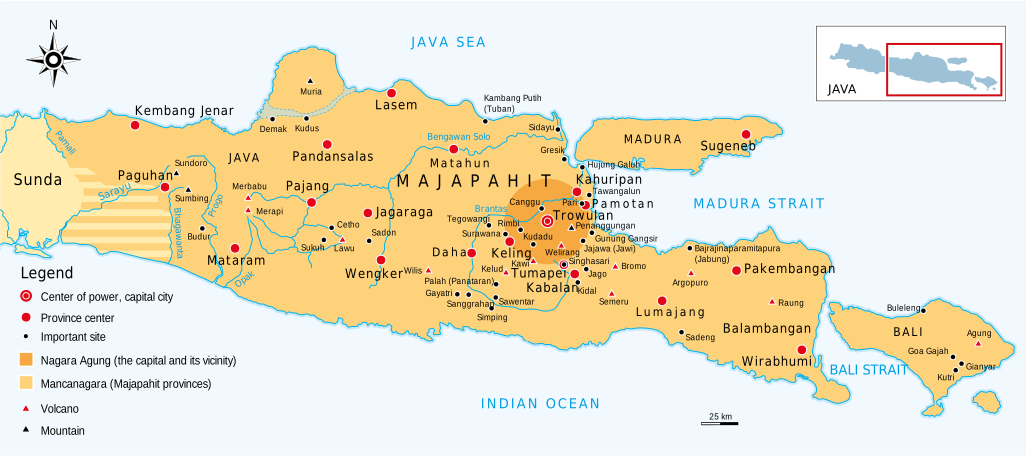
That year, a Javanese court poet named Mpu Prapanca wrote an epic listing the territories under the Majapahit empire. Palembang was in it. 4,5
This was not an honor. It was a list of subjugation.
Seeking an Edict of Investiture#
Twelve years later, things changed.
In 1377, the ruler of Palembang sent an envoy to the Ming Dynasty requesting investiture. The Ming court agreed and officially gave its recognition. 1,5
Then Majapahit sent its army.
From a vassal state seeking independent recognition from a stronger foreign power, to the suzerain deploying troops to suppress it — historians generally believe there is a direct connection between these two events: the investiture was the first step toward breaking away from the suzerain, so Majapahit treated it as a rebellion. 4,5
But one thing must be made clear: the causal chain that "they were attacked because they sought investiture from the Ming court" has only been traced to the level of academic syntheses; clear, direct evidence has not been found in contemporary primary records with page numbers. This is a deduction by historians, not black-and-white text from a contemporary document. 5,4
We can only say: the two events occurred one after the other, and the distance between them was very short.
In 1377, Srivijaya ended as a functioning political entity. 4,5
The Man#
It was against this backdrop that a man and his followers boarded a ship and left Palembang.
Portuguese documents called him Paramiçura. Chinese texts transliterated it as Bai-li-mi-su-la. This was not his real name — that real name has not been seen in public records.
"Parameswara" is Sanskrit.
Parama means "supreme," and īśvara means "lord." Together, they form an imperial title in the Sanskrit tradition on par with "king of kings." 6,2
This is worth stopping to think about.
A person who would later be recorded as the founder of an Islamic sultanate carried a Sanskrit title from the Hindu-Buddhist world as his public designation. He took this title, left Palembang, left the Indianized court tradition that sustained Srivijaya for centuries, and boarded a ship.
He later used this title to found Malacca.
"Parameswara" was a reusable royal title within the Malacca dynasty — the fourth Sultan's full title also contained this word. 6,2 This indicates that from the very beginning, it was not a personal name, but a title that one person could receive, and the next person could receive again.
Temasek#
His first stop was Temasek — around modern-day Singapore.
The Portuguese document Suma Oriental describes that he seized power from a local ruler there (whom Pires called Temagi), killed him, and ruled for about five years. 2,3
The Sejarah Melayu (Malay Annals) narrative of this scene is completely different — the last king of Singapura in that book was named Iskandar Shah, who lost his kingdom after being betrayed to Majapahit by a traitor, rather than being killed by a foreign prince. 3,2
This is not a minor discrepancy in details. These are two fundamentally different stories, each serving different narrative needs.
He was later expelled from Temasek. Who drove him out? Here again, there are two accounts — Portuguese documents say it was Siamese retaliation, while Malay tradition says Majapahit attacked. 2,3 The two sets of documents are independent, yet the conclusions are opposite. This site does not make a judgment for either.
Where Did He Stop in Between?#
After leaving Temasek, according to the Sejarah Melayu, he temporarily stayed around the banks of the Muar River, set up camp at a place called Biawak Busuk, and founded another settlement called Kota Buruk, before deciding it was not a place to stay long and continuing north.
This section is only recorded in the Sejarah Melayu; Portuguese documents are silent on it.
We must clarify what kind of book the Sejarah Melayu is. Its extant version was compiled by the Johor court in the early 17th century — two hundred years after the founding of Malacca. It is a literary history intended to sanctify the court, not a contemporary record. It is cited because it preserves some narratives unavailable elsewhere; but its specific details, if uncorroborated by independent sources, can only be treated at the level of legend, not written as fact. 3,2
The stop at Biawak Busuk is exactly such a case.
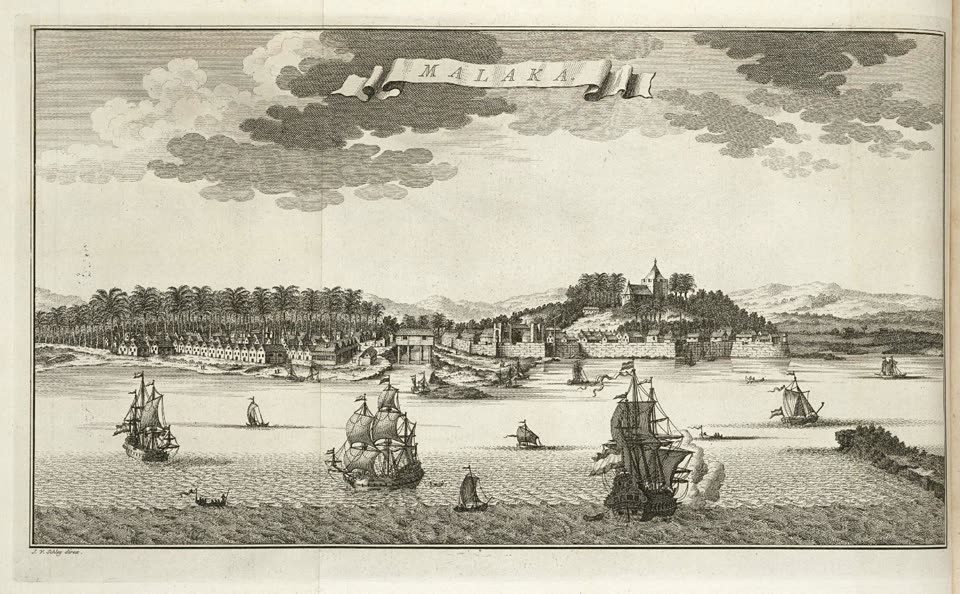
Malacca#
He eventually arrived at the banks of Sungai Bertam.
The Sejarah Melayu says the inhabitants there were the Orang Seletar (Orang Laut, Sea Nomads), and it was they who asked him to be king. If true, this detail is very important — Malacca's founding was not a conquest, but an invitation by the local sea nomads. But this too relies solely on the Sejarah Melayu and must be treated as a legend.
He rested under a tree and saw a mouse deer kick his hunting dog into the water — this legend is only found in the Sejarah Melayu and is not recorded in Portuguese texts, so it is mentioned here but not used as evidence.
He called that place Melaka.
Where did this name come from? There are three theories, none conclusive: The Sejarah Melayu says it came from a melaka tree; in the Suma Oriental, Pires gave another answer — it came from the Malay word for "fugitive" (malaqa), which he felt fit Parameswara's identity perfectly. 2,3 This is Pires' interpretation, not an etymological proof, but it is worth recording: a Portuguese, after conducting local interviews in Malacca, linked the name of this port city to the fugitive experience of its founder.
The Birth of a Port#
As for the year he arrived in Malacca, three materials give three numbers: Malay textbook tradition uses 1400; Pires' narrative calculates to about 1402; and Ming Dynasty diplomatic contacts provide another timeline — in 1403, the Ming court dispatched the eunuch Yin Qing as an envoy to Malacca, and by then, the port was already there. 1,2
None of these three numbers comes from a contemporary primary source.
The academic community generally uses between roughly 1400 and 1403. This is the honest way to write it. 1,2,5
The arrival of Yin Qing's envoy in 1403 is the earliest verifiable lower bound for Malacca's existence — by then, it was already a port capable of receiving imperial envoys. 1,2
In 1405, the Ming court officially invested Bai-li-mi-su-la as the King of Malacca. 1,5
On August 14, 1411, accompanied by his wife (called "Ba-er-mi-su-li" in the Ming Shilu), son, and ministers, totaling over 540 people, he traveled to Nanjing for an imperial audience. 1,5 The Yongle Emperor hosted a banquet at Fengtian Gate and bestowed colorful clothes, Qilin robes, gold and silver utensils, and bedding. A man who was merely a fugitive at the end of the 14th century arrived at the imperial capital of China in the early 15th century with 540 people.
This is verifiable.
Who Was He?#
After his death, a highly significant record appeared in the Ming court archives.
In 1414, the "son of the King of Malacca" arrived in Nanjing, reported his father's passing to the emperor, and requested to inherit the title — this prince is recorded in the Ming Shilu as "Mu-gan Sa-yu-di-er Sha," which is Megat Iskandar Shah in Malay historiography. 1,2
Two names. Bai-li-mi-su-la and Megat Iskandar Shah. The Ming court met the former in 1411 and the latter in 1414, explicitly recording the latter as the son of "his father."
So were these two men the same person, or were they truly father and son?
To this day, academia has no conclusive answer. 7,8,9
In his 1968 paper, Wang Gungwu argued that the Ming court met the man in person in 1411, and it was unlikely they would mistake his identity three years later. He concluded that they were two successive rulers.
The reading of another camp is exactly the opposite: given the three-year gap and confusing transliterations, it is not impossible for Ming officials to make a mistake; Parameswara converted to Islam in his later years and changed his name to Iskandar Shah, so the two names actually belong to the same person.
Wake's stance is more radical: he believes Parameswara never converted to Islam, and that "Iskandar Shah" was a posthumous title added later.
Thomaz chooses to answer honestly: Based on available materials, this question cannot be answered.
As for exactly when Parameswara converted to Islam, or if he did at all — academia is similarly divided, with no consensus. Some researchers point out that Islam was only truly and firmly established among the populace in Malacca during the reign of Muzaffar Shah (roughly 1445–1459), quite a long time after Parameswara's death. 7,8
This site's stance: Make no ruling. Lay out the four positions and let the readers see for themselves.
What happened to this port next came very quickly.
The Chinese arrived, not for the first time, but this time bearing a mission and gifts. South Asians arrived, bringing cotton cloth and spices, as well as a faith that was becoming increasingly important in the Strait of Malacca. And then someone figured out a way for everyone to stay here — without asking about your bloodline, only asking from which direction your ship came.
Sources 9 Every important claim here can be checked. Open it and see.
Do not trust this site. Check it — every source below is clickable.
-
Search for this source ⌕ no direct link — this button searches for the work 2026-07-30 Report this source
-
Search for this source ⌕ no direct link — this button searches for the work 2026-07-30 Report this source
-
Search for this source ⌕ no direct link — this button searches for the work 2026-07-30 Report this source
-
Search for this source ⌕ no direct link — this button searches for the work 2026-07-30 Report this source
-
Search for this source ⌕ no direct link — this button searches for the work 2026-07-30 Report this source
This site is written with AI assistance. Please check us.
AI can invent citations that look completely convincing — a real author's name, a plausible title, a sensible year, for a work that does not exist. This is not a theoretical risk; it is a known failure mode. That is why every source on this site is clickable. If a reference cannot be found anywhere, it may well not exist — and we want to know.
How to check us →
Reader Comments
Be the first to share your thoughts.