Why Did the Malayan Campaign Fall in Seventy Days?
Everyone has heard that "Singapore's guns were pointing out to sea". That claim is popular because it reduces defeat to an act of sheer stupidity
Let us first address the claim everyone has heard.
Singapore's guns were pointing out to sea, completely unable to fire at the Japanese forces coming from the land.
This claim has circulated for eighty years. It is concise, highly visual, and carries a hint of vindictive pleasure — a group of arrogant Britons pointed their gun barrels in the wrong direction and consequently lost. Churchill himself reinforced a similar notion in his post-war memoirs.
A part of it is true. But what truly rendered those guns ineffective was not the direction they were pointing.
The First Layer: Could the guns traverse#
Singapore at the time had fifty-one coastal defence guns, divided into two categories: close-defence guns and anti-ship guns. Among them were five 15-inch calibre guns — three at the Johore Battery and two at the Buona Vista Battery.
They could traverse. And starting from 5 February 1942, those guns that could be turned northward did indeed open fire on the Japanese forces.
What could not traverse were some of the fixed 6-inch guns. Therefore, the statement "the guns were pointing entirely out to sea and could not fire northward," as a factual statement, is false.
The Second Layer: What was the real problem#
The Australian official war history The Japanese Thrust, Chapter Fourteen, verbatim:
"Some of the guns, however, were incapable because of location, lack of range, or limited traverse of being used against targets in Johore. The heavy guns useable for the purpose had very little high-explosive ammunition, and their armour-piercing shells were relatively ineffective against land targets because the shells were apt to bury themselves deep in the soft ground, which muffled the force of their explosion."
The heavy guns usable for firing towards Johore had almost no high-explosive ammunition; they were equipped with armour-piercing shells, and armour-piercing shells were highly ineffective against land targets — the shells would bury themselves deep into the soft ground, which muffled the force of the explosion.1,2
Armour-piercing shells are designed to penetrate warship armour: penetrate first, then explode. When fired into the muddy ground of jungles and rubber estates, they simply burrowed into the earth and blasted a crater underground.
The problem was not where the gun barrels were pointing. The problem was that those guns were prepared for a different war.
They were mounted there to prevent a fleet coming from the sea. The entire design was based on the premise: the threat would come from the sea.
Instead, the Japanese forces came from the land, from the north, riding bicycles through rubber estates.
The Third Layer: Why the claim is so convenient#
Now look back at the most widely circulated claim.
"The guns were pointing the wrong way" is a story about stupidity. Stupidity can be mocked, and it can be corrected — just replace them with smarter people who will turn the guns around.
"The ammunition was prepared for a different war" is a story about assumptions. The entire defence — the location of the guns, the type of ammunition, the deployment of troops, and even the very concept of the Singapore fortress itself — was built on an untested premise. When the premise is wrong, even the most sophisticated preparations are useless.
This site argues that the second story is the true lesson of those seventy days, and it is much harder to digest than the first. That is why the first story survived.
Seventy Days#
| Date | What happened |
|---|---|
| 8 December 1941, pre-dawn | Japanese forces landed in Kota Bharu |
| 10 December | Prince of Wales and Repulse were sunk off the coast of Kuantan |
| 12 December | The Jitra line (Kedah) collapsed |
| 19 December | Penang fell |
| 7 January 1942 | The Battle of Slim River, two Indian brigades shattered, the gateway to Kuala Lumpur wide open |
| 11 January | Kuala Lumpur surrendered without a fight |
| 31 January | Commonwealth forces completely withdrew across the Causeway, the Causeway was blown up |
| 8 February | Japanese forces crossed the Johore Strait |
| 15 February | Percival surrendered |
(The timeline is cross-referenced using relevant Wikipedia articles and several war history sites; this site did not verify every item back to the original battle reports, so treat it as a framework rather than an exact record.)
Regarding the moment the war broke out, one detail is worth clarifying because it is often written incorrectly.
The Australian official war history records: a force of about 5,500 men commanded by Major General Takumi, carried by three ships under naval escort towards Kota Bharu, dropped anchor at 10:20 p.m. The seas were rough, and lowering the landing craft and maintaining direction proved very difficult.1,3
Wigmore does not provide the exact minute the troops stepped onto the beach. The commonly cited "1:45 a.m." is actually the result of converting the moment of the Pearl Harbor attack (7:55 a.m. Hawaii time) into Malayan time — military histories use it to illustrate that firefights were already underway in Malaya before Pearl Harbor was bombed.
Wigmore states this very clearly: The landing at Kota Bharu occurred before the attack on Pearl Harbor.1,3
The first shot of the Pacific War rang out on this land.
Who was actually fighting the Japanese forces#
"The British could not hold Malaya" — this has been said for eighty years, and it conceals a fact: the people manning the defensive lines were mostly not British.
Jitra: The battalion designations are the answer#
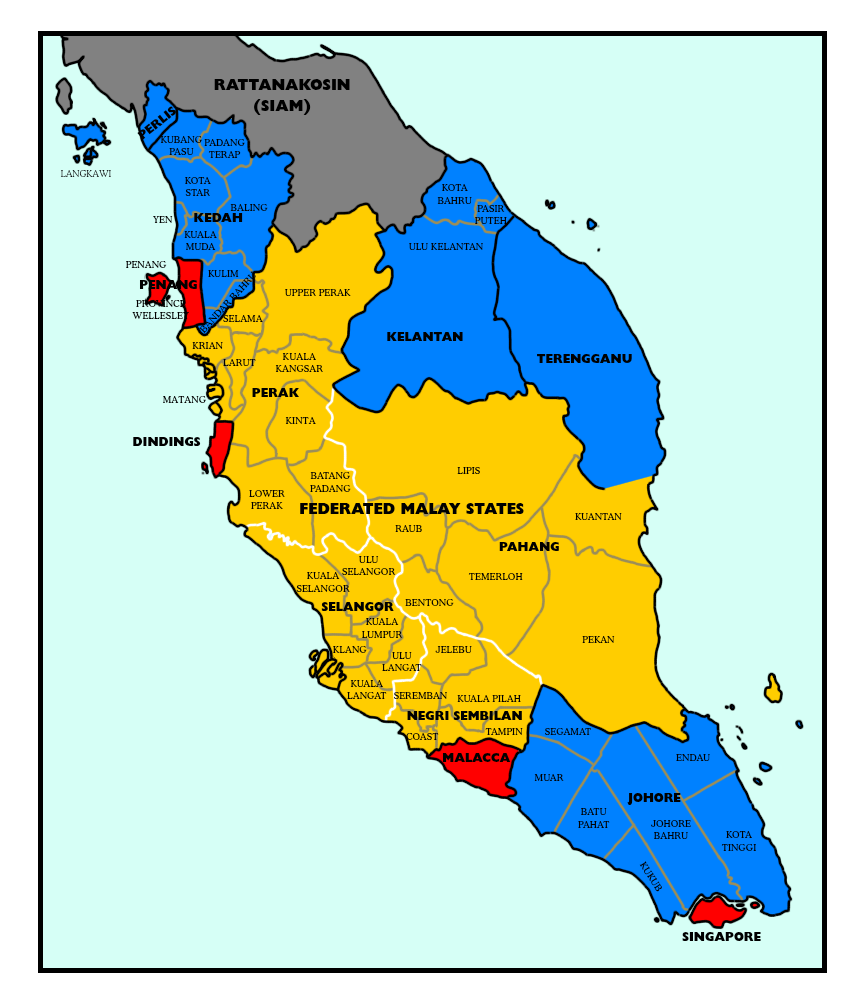
From 11 to 13 December 1941, the Jitra defence line in Kedah. This was the first large-scale positional battle of the Malayan campaign.
The composition of the defenders, recorded verbatim in Chapter Eight of the Australian official war history:
| Unit | Subordinate Battalions | Defence Frontage (Yards) |
|---|---|---|
| 15th Brigade | 2/9th Jat · 1/Leicester · 1/14th Punjab | 6,000 |
| 6th Brigade | 2/East Surrey · 2/16th Punjab · 1/8th Punjab | 18,000 |
| 28th Brigade (Reserve) | 2/1st Gurkha · 2/2nd Gurkha | — |
The British Indian Army was organised into "class regiments", so the battalion designation itself specified where the troops came from: Jat (North Indian Jats) · Punjab (three battalions) · Gurkha (Nepal, two battalions) · Leicester and East Surrey (England).
Out of nine battalions, six were from South Asia and Nepal.
Look first at the defence frontage. The 6th Brigade had to hold eighteen thousand yards — over sixteen kilometres. A normal defensive front for a brigade is usually a few thousand yards. This line was paper-thin from the start.
The Japanese committed their 9th Infantry Brigade (the 41st and 11th Regiments).
Then the casualties#
On the defenders' side, Wigmore records: after the battle, the 15th Brigade was "barely 600 strong"; the 2/1st Gurkha was reduced to one company; two battalion commanders and twenty-five officers were killed or missing.1,3
On the Japanese side, Wigmore cites post-war Japanese records: twenty-seven killed, eighty-three wounded.1,3
Read these two lines side by side.
A brigade fought until barely six hundred men were left. The opposition lost twenty-seven men.
Slim River: 7 January, pre-dawn#
On 7 January 1942, Slim River, Perak. The Japanese 42nd Infantry Regiment, supported by a tank battalion, thrust straight down the trunk road.
The defenders were the 12th Brigade (Brigadier Stewart) and the 28th Brigade (Brigadier Selby).
On 8 January, when counting the remaining troops, Wigmore records verbatim:
- 12th Brigade: 14 officers, 409 men
- The two battalions of the 28th Brigade combined: about 750 men
- 2/1st Gurkha: "had been lost" — the entire battalion was gone
- Argyll and Sutherland Highlanders (Argylls, Scotland): "all but about a hundred…were lost"
⚠️ Regarding this battle, a set of figures circulates stating "about 5,000 committed, about 1,173 survived". This site clarifies: these two figures do not appear in Wigmore's main text. He only provides the post-battle remaining strength, not the total committed. The figures come from a secondary war history website, which this site is unable to verify; hence, both accounts are presented side by side without being merged.
Reaching Singapore island, the table becomes clearer#
The composition of the defending forces on Singapore island in early February 1942 is broken down by origin in Chapter Fourteen (page 285) of Wigmore:
| Origin | Battalions |
|---|---|
| India | 21 |
| Britain | 13 |
| Australia | 6 |
| Malaya | 2 |
| Straits Settlements Volunteer Force (SSVF) | 3 |
| Total | 45 battalions, approx. 85,000 men |
Out of forty-five battalions, twenty-one were Indian battalions. Adding the Gurkha troops from Nepal (structured within the Indian Army), troops from the South Asian subcontinent and the Himalayas made up nearly half the entire defending force.
This is the answer to "who was fighting the Japanese forces": predominantly people from Northern India, Punjab, and Nepal, alongside the British, Australians, two Malay battalions, and three local volunteer battalions.
Most of them heard place names like Jitra, Slim River, and Pasir Panjang for the very first time in their lives when they were deployed there.
Two figures this site cannot provide#
The casualties of the 1st Malay Battalion at Pasir Panjang — Wigmore records the battle and Percival's comment that "garrisons of posts... were wiped out almost to a man", but provides no specific figures. Circulating figures like "1,400 men" originate from post-war narratives and commemorative institutions, which this site is unable to verify.
The total number of personnel in Dalforce — Wigmore confirms its existence, commander, and role, but gives no numbers. The common figure of "about 4,000 mobilised, of which about 1,250 were armed" comes from Wikipedia, which this site is also unable to verify. Its political makeup (mainly the Malayan Communist Party, alongside the Kuomintang faction and non-partisans) is also found only in secondary sources.
This site prefers to leave these two blanks empty.
And a group of people switched sides#
During the same campaign, something else happened.
On 15 December 1941 — just one week after the war started — Mohan Singh, an officer in the 1/14th Punjab Regiment of the British Indian Army, met with Japanese Major Iwaichi Fujiwara at a rubber estate near Jitra, Kedah.
On 31 December, the Indian National Army (INA) was declared formed in Taiping, Perak.
In other words: among the troops who had fought on the Jitra line, some became soldiers of another army within weeks.
⚠️ Regarding how many joined and how many refused, the figures this site found (about 16,000 joined, about 15,000 to 20,000 refused) exist only in secondary sources and could not be verified. But the fact that "some joined, and some refused" is established — and that is the part most worth remembering.
Regarding these individuals, this site has a separate article under They Used to be Neighbours.
The people on the list, and those who were not#
Military history usually concludes with a surrender. This piece will go on a little longer, because that phase determined the politics of the next twenty years.
The 1st Malay Battalion#
At Pasir Panjang in southwestern Singapore (around present-day Bukit Chandu), the 1st Malay Battalion fought a hard battle.
Chapter Seventeen of the Australian official war history records:
"The 1st Malay Battalion, a regular unit, officered principally by Englishmen familiar with the language and customs of their men, showed during the struggle for the ridge how well more such forces could have been employed in the defence of their homeland. Despite their determined resistance, however, they were gradually overpowered."
A footnote in the same chapter quotes Percival's own account:
"Garrisons of posts held their ground and many of them were wiped out almost to a man. It was only when it was weakened by heavy losses that a regiment was forced to give ground."
The garrisons held their ground and many of them were wiped out almost to a man.1,3
⚠️ A distinction must be made here. The name Adnan Saidi does not appear in this original text by Wigmore. The specific story of the lieutenant commemorated today in Malaysia and Singapore stems from post-war narratives and commemorative institutions, and is not found in this 1957 official war history.
The battle is a fact in the records; the name is how it was remembered later. Both are true, but their evidentiary levels differ, and this site does not conflate them.
Dalforce#
When Singapore could not be held, Percival decided to rapidly expand an irregular Chinese force. Chapter Fourteen of the Australian official war history records:
"Percival arranged to expand rapidly the force of Chinese irregulars (Dalforce) which had been operating in an auxiliary role on the mainland under Lieut-Colonel J. D. Dailey, of the Federated Malay States Police Force."
"Detachments from Dalforce were allotted to area commanders to patrol swamp areas where landings might occur, and act as a nucleus of such fighting patrols as might operate on the mainland."
They were sent to patrol the swamp areas — the most likely places for a Japanese landing.1,3
(The commander's name, spelled Dailey by Wigmore, is more commonly spelled Dalley in other records, referring to the same person.)
On 13 February 1942, two days before the surrender, Dalforce was disbanded. According to later records, each man received ten Straits dollars.
The Indian Troops#
The two Indian brigades were shattered at Slim River. And during that same campaign — on 31 December 1941, a month and a half before the surrender of Singapore — Mohan Singh announced the formation of the Indian National Army (INA) in Taiping.
An army fighting for the British King began to splinter into two on the exact same battlefield.
That List#
There was a list for the evacuation ships departing Singapore. Chapter Seventeen of the Australian official war history records:
"It was decided to send in them principally service people and civilians who could be spared, and also some chosen because their experience and knowledge would be useful elsewhere."
That is: priority to service personnel, civilians who could be spared, and those chosen because their experience and knowledge would be useful elsewhere.
Regarding the rest, the same chapter states:
"Most of the civilians, especially the Asians, were pitifully exposed to the effects of bombardment, and without prospect of evacuation."
Most of the civilians — especially the Asians — were pitifully exposed to the effects of bombardment, and without prospect of evacuation.1,3
Another sentence reads:
"Desperate men no longer with their units, and civilians not listed for evacuation but determined to escape, also sought to take what opportunity offered."
"Civilians not listed for evacuation" — this phrase inherently confirms the existence of a list system.
⚠️ This site must pause here and clarify where the evidence stops.
"Whites first" is a widely circulated post-war notion. This site's findings: the Australian official war history records inequality in outcome (Asian civilians having "no prospect of evacuation," the existence of "civilians not listed"), but it uses no racial quotas or "whites first" terminology, nor has this site found any written racial evacuation policy document.
Therefore, this site writes: Records show the outcome was unequal; this site has found no document proving this outcome was the result of a written policy. These two sentences are different, and this site will not write the latter as if it were the former.
What those seventy days truly shattered#
Before 1941, the political order of this land was built on an unspoken premise that nonetheless underpinned everyone's calculations:
The British could hold it.
The Malay Sultans had surrendered their administrative powers after 1874 in exchange for protection. Chinese and Indian communities ran businesses, sent their children to school, and remitted money home under colonial rule — the arrangement functioned because someone maintained order.
After seventy days, that premise was gone.
It was not overturned by debate, it was witnessed: warships sunk at sea, Kuala Lumpur surrendering without a fight, the Causeway blown up by their own hands, Asian civilians waiting on the docks for ships that would never come, and finally, a marching column bearing a white flag.
Everything that happened over the next three years and eight months, as well as the realignment of all political forces in the decade after the war, began once this premise evaporated.
The evidence for this piece, clearly explained#
The hardest evidence comes from an official war history of one of the belligerent parties.
Lionel Wigmore's The Japanese Thrust (Australia in the War of 1939–1945, Series One: Army, Volume IV, 1957) is the source for the four paragraphs covering coastal gun ammunition, Dalforce, the 1st Malay Battalion, and civilian evacuation. The Australian War Memorial digitised this war history, and this site read the text layer of the PDFs, verifying word for word, not relying on secondary citations.
However, it is an official war history written by a belligerent party, not a neutral narrative. Its account of Commonwealth troops and its handling of command failures carry the perspective of that position. This site cites it because it is the strongest source with accessible main text, not because it is neutral.
Two books this site could not read: Kirby's British official war history Volume I, and Brian Farrell's The Defence and Fall of Singapore — neither has fully readable text available on archive.org. If these were accessible, the sections on coastal guns and evacuation could be tightened further.
The timeline is the result of secondary cross-referencing, not item-by-item verification against original battle reports. Treat the dates and place names as a framework.
The section on unit compositions and casualties clearly indicates its evidentiary strengths and weaknesses in the main text: the battalion designations at Jitra, defensive frontage, post-battle remaining troops, Japanese casualties, and the 8 January tally at Slim River, as well as the origins of the 45 battalions on Singapore island — all read directly from Wigmore's main text. Conversely, "Slim River 5,000 committed / 1,173 survived", the casualties of the 1st Malay Battalion, the size and political makeup of Dalforce, and the numbers joining or refusing the INA — Wigmore provided none of these, nor could this site verify them, so they are either presented as competing claims or left blank.
The issue of coastal gun ammunition now rests on two legs: the Australian official war history (primary) and an article by the Naval Historical Society of Australia citing official archives (secondary). This is the most solid part of this piece.
The name Adnan Saidi is not in Wigmore's main text, which this site has explicitly noted in the relevant paragraph.
Next piece: Three Years and Eight Months. The occupiers kept a separate ledger for each community.
Sources 3 Every important claim here can be checked. Open it and see.
Do not trust this site. Check it — every source below is clickable.
-
Search for this source ⌕ no direct link — this button searches for the work 2026-07-30 Report this source
-
Search for this source ⌕ no direct link — this button searches for the work 2026-07-30 Report this source
This site is written with AI assistance. Please check us.
AI can invent citations that look completely convincing — a real author's name, a plausible title, a sensible year, for a work that does not exist. This is not a theoretical risk; it is a known failure mode. That is why every source on this site is clickable. If a reference cannot be found anywhere, it may well not exist — and we want to know.
How to check us →
Reader Comments
Be the first to share your thoughts.